RIT 141-150 Activities: What to Teach Math and Reading at This Band
Your student tested at RIT 145. Maybe RIT 148. Somewhere in the 141-150 band — kindergarten and early-1st-grade foundational territory, plus older students working through significant intervention gaps. Now you need to figure out what to actually teach them this week.
This post is the answer for the 141-150 band specifically. Math AND reading skills broken down to what students at this band are ready to learn next, with activity ideas you can pull tomorrow morning. Built for K-5 teachers and interventionists who already know how to teach and just need the band-by-skill bridge.
The free score tracker linked at the bottom is what most teachers use to keep their group rosters and priority skills straight all year. Grab it before you start planning.
Who’s at RIT 141-150?
This band typically captures three student groups:
- Kindergarten students through the second half of the year. Winter and spring norms for kindergarten typically land in this band, so K students testing here are exactly where they’re expected to be.
- 1st graders early in the school year. Many 1st graders test here in fall before consolidating phonics fluency through the year.
- Students in 2nd grade and beyond receiving Tier 3 intervention. Older students testing at this band are working on filling significant foundational gaps, often with special education or intensive intervention support.
Same RIT band, very different grade-level contexts. The skills are identical regardless of grade — which is exactly why band-based grouping works for interventionists pulling across grade levels. A 2nd grader at RIT 145 and a kindergartener at RIT 145 are working on the same foundational skills.
Math Skills at RIT 141-150
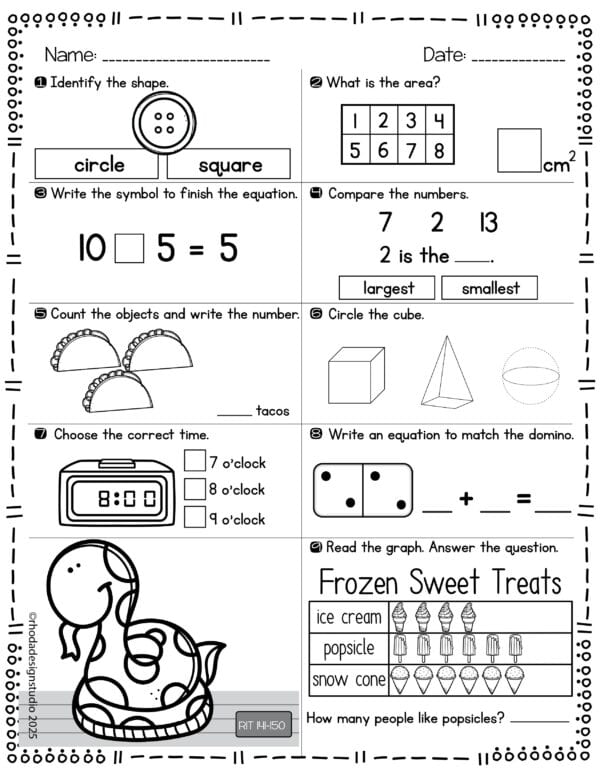
Math at this band is the foundational number-sense layer. Students are working on number recognition, basic counting, and addition and subtraction within 10. The skill list is genuinely shorter than at higher bands — that’s normal and expected at this developmental level.
Operations & Algebraic Thinking
Students at RIT 141-150 are working on:
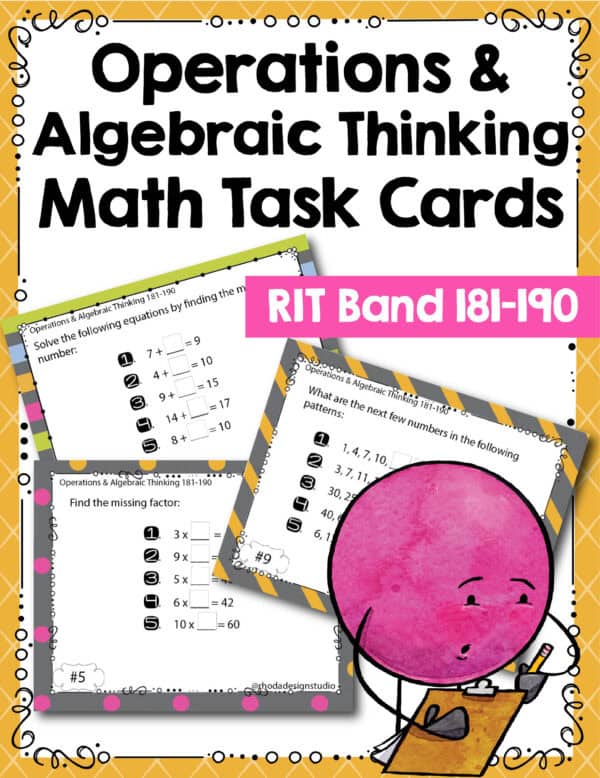
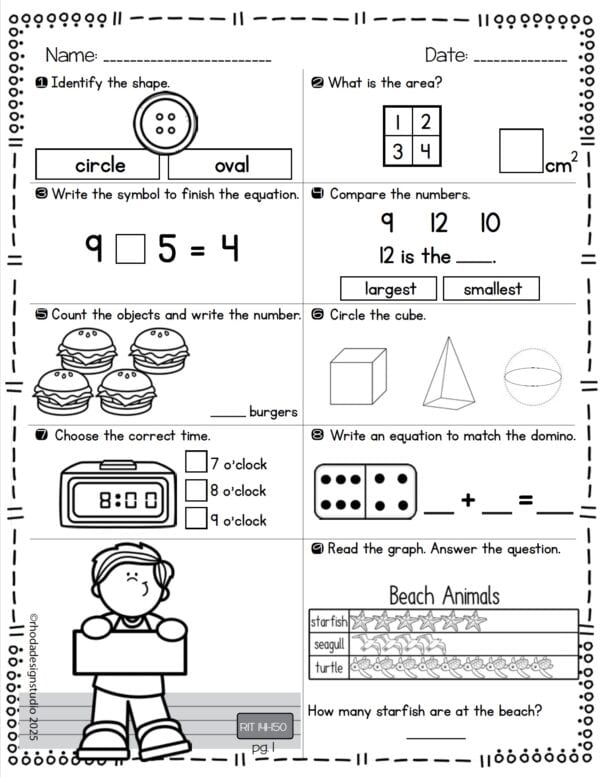
- Matching number sentences that give the same answer (commutative property of addition: 2+3 = 3+2)
- Representing addition word problems with manipulatives (numbers less than 10)
- Solving addition word problems with manipulatives
- Determining basic addition facts (sum less than 10)
- Determining basic subtraction facts (numbers less than 10)
Activity ideas for Operations
- Counter manipulatives for every addition problem — students count out the first set, then the second set, then count all together. Concrete first, always.
- Five-frame and ten-frame work — visual support for understanding how numbers combine to make sums under 10
- Story problem cards with picture supports — short word problems with illustrations that show the action (combining or taking away)
- Number sentence matching — given 4+2, students find the equation that means the same (2+4) using picture cards
Number & Operations
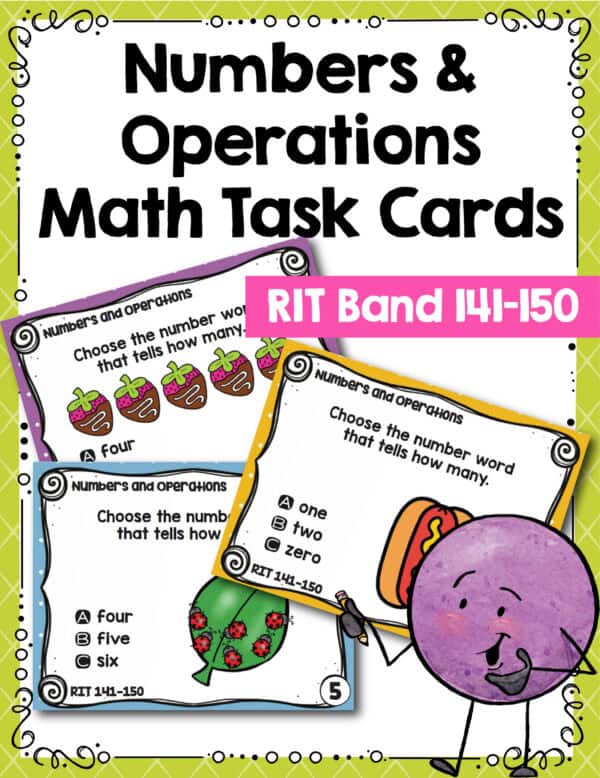
- Representing a set of objects as a number word (e.g., a set of 6 objects = “six”)
- Determining basic addition facts with sums less than 10
- Determining basic subtraction facts with numbers less than 10
Measurement & Data
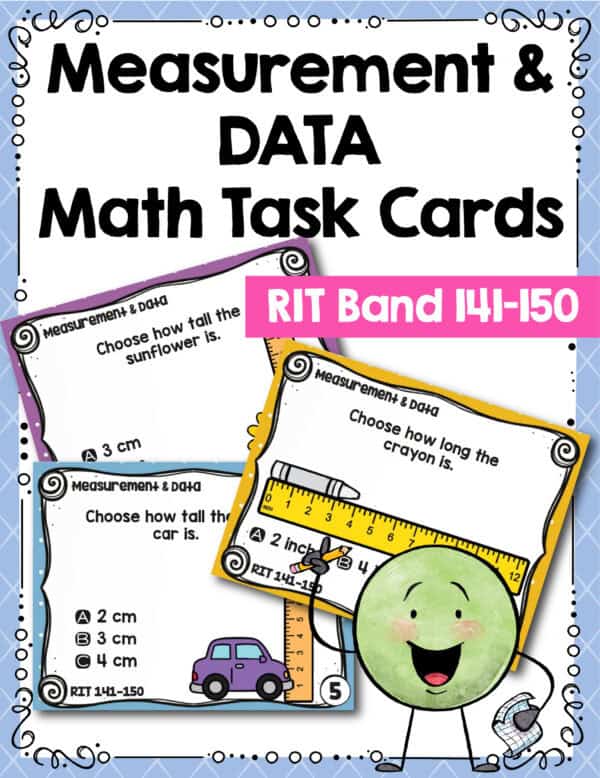
- Reading a ruler in centimeters (height)
- Reading a ruler in inches
- Measuring the height of an object in inches (with a ruler given)
- Reading an analog clock to the nearest hour
Geometry
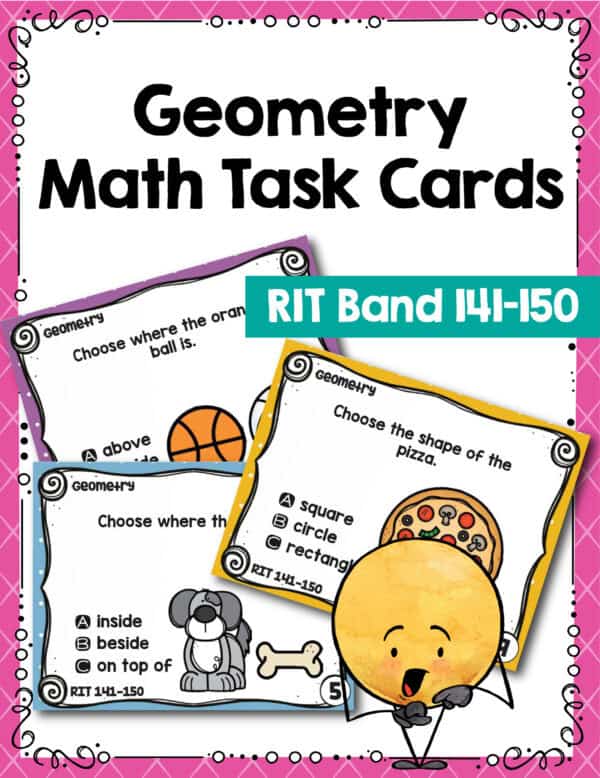
- Understanding location words (e.g., “besides,” “next to”)
- Naming circles using real-world objects
- Naming rectangles when manipulatives are shown and shape names are given
Activity ideas for Measurement & Geometry
- Ruler exploration centers — students measure classroom objects with both inches and centimeters, recording in a simple table
- Analog clock matching cards — students match clocks showing whole hours to the corresponding digital times
- Shape sorts with real objects — circles (cans, plates), rectangles (books, tablets), squares (sticky notes)
- Position word obstacle courses — give directions using “next to,” “beside,” “between” and have students follow them
Reading and Language Skills at RIT 141-150
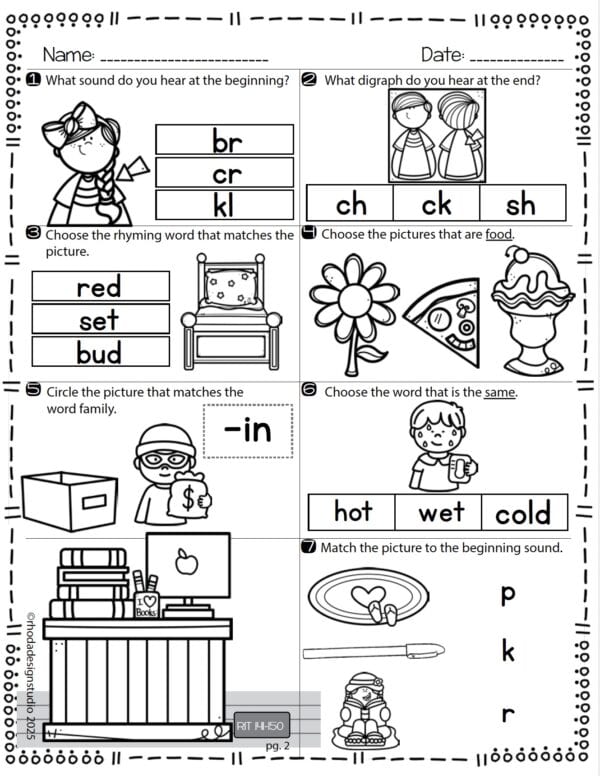
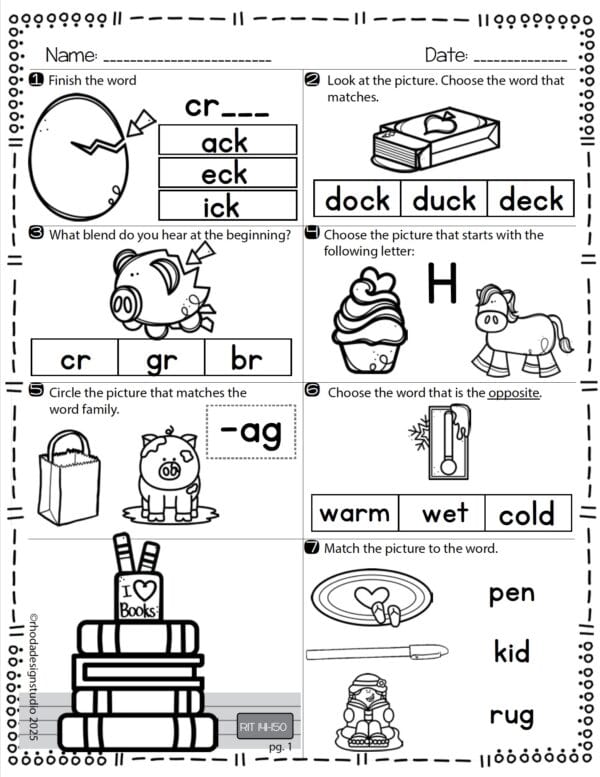
Reading at this band is heavily phonics- and print-concepts-driven. Students are working on the foundational skills that make decoding possible — letter-sound correspondence, blending sounds, and recognizing high-frequency sight words.
Phonics & Foundational Skills
- Identifying parts of a book (back, title, front cover)
- Matching letters to beginning sounds (fr, gl, short a, n, j, r, l, qu, b, tw, sl)
- Recognizing the letter that makes a given sound (b, v, l)
- Blending three sounds together to create a word
- Substituting beginning sounds in words
- Identifying sight words in isolation and in sentences (funny, in, it, is, big, give, blue, are, all, away, will, for, after, come, little, they, every, could, going, had, under, was, has, be)
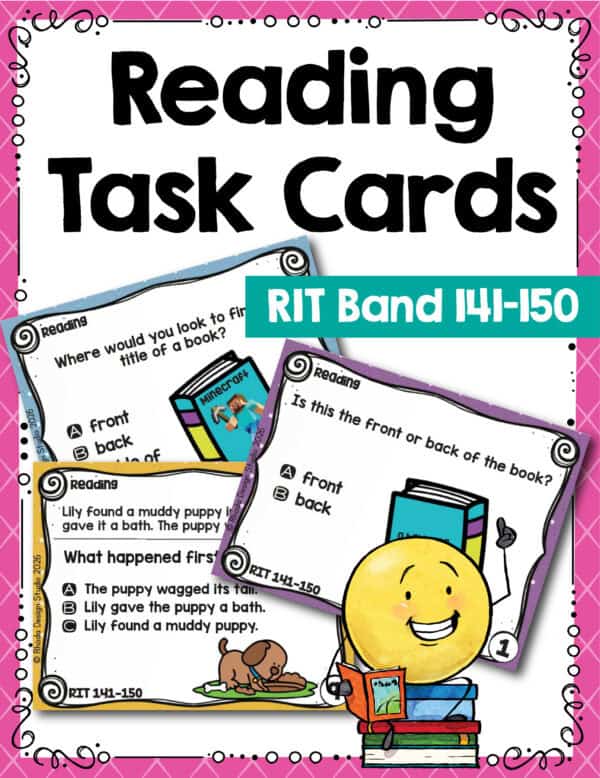
Activity ideas for Phonics & Foundational Skills
- Letter-sound flashcards in daily 2-3 minute drills — start with focus letters of the week and add as students master them
- Beginning sound picture sorts — students sort pictures by which letter they begin with
- Blending board practice — single phonemes that students physically push together to form a word (c-a-t → cat)
- Sight word fluency rings — small flashcard rings of target sight words students review every day with the teacher
- Book parts hands-on — students physically point to and name front cover, back cover, title, author
Reading Literature
- Asking and answering questions about key details in a text
- With prompting and support, retelling familiar stories including key details
- Describing characters, settings, and major events in a story using key details
- Using illustrations and details in a story to describe characters, setting, or events
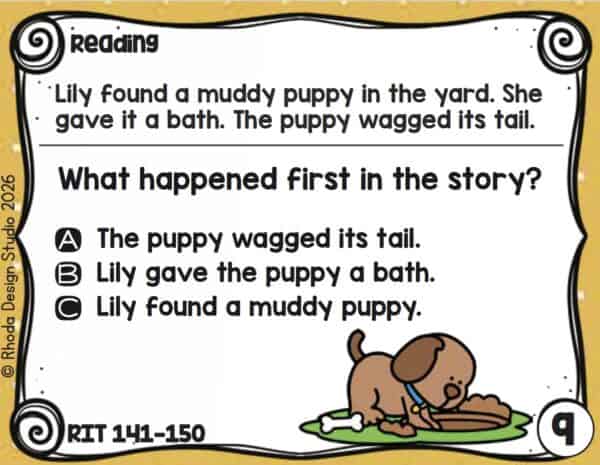
Reading Informational Text
- Asking and answering questions about key details
- Identifying the main topic and retelling key details of a text
- Inferring the cause of a given effect
- Identifying parts of a book (back, title, front cover)
- With prompting and support, describing the relationship between illustrations and the text
Activity ideas for Reading Comprehension
- Read-aloud with question prompts — pause every few pages to ask “who is in this story” or “what just happened”
- Story sequence picture cards — beginning, middle, end cards from a familiar story; students put them in order
- Picture-text matching for comprehension — given an illustration from a familiar book, students match the sentence that goes with it
- Cause-and-effect picture cards — pairs of pictures (it rained / the ground is wet) that students match
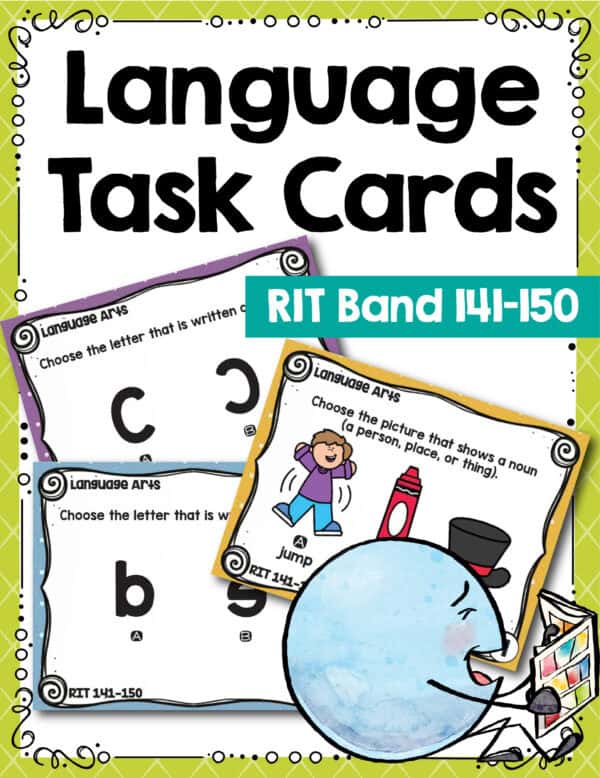
Language Arts
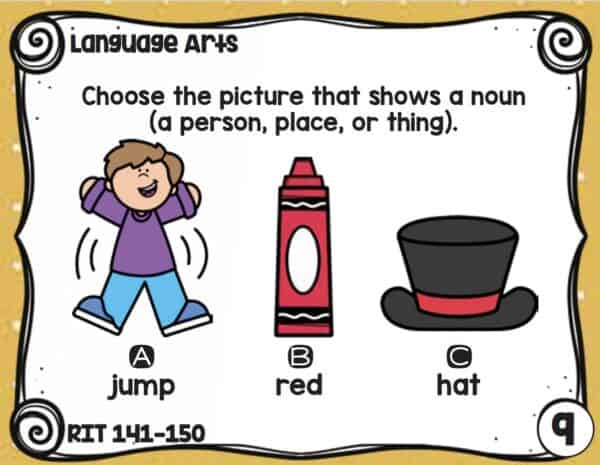
- Recognizing the correct way to print upper and lowercase letters
- Using frequently occurring nouns and verbs
- Identifying the appropriate preposition (next to)
- Identifying a complete sentence and creating sentences using given words (three-word sentences)
- Capitalizing the first word in a sentence and the pronoun “I”
- Recognizing and naming end punctuation; identifying an exclamation point
- Determining spelling patterns that complete a word (-at, -uck, -ing)
- Spelling sight words correctly (he, can, you, and, be, am, as, five)
- Identifying the words that create contractions (I’m)
- Using frequently occurring adjectives
- Sorting pictures in order (first, next, last)
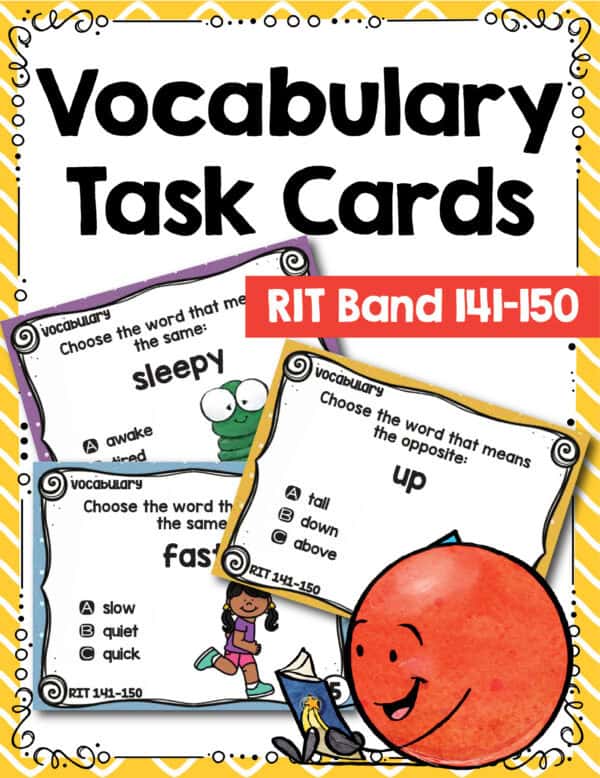
Vocabulary
- Identifying new meanings for familiar words and applying them accurately
- Using sentence-level context as a clue to word meaning
- Using frequently occurring affixes as a clue to word meaning
- Sorting common objects into categories; classifying pictures and words into groups
- Identifying real-life connections between words and their use
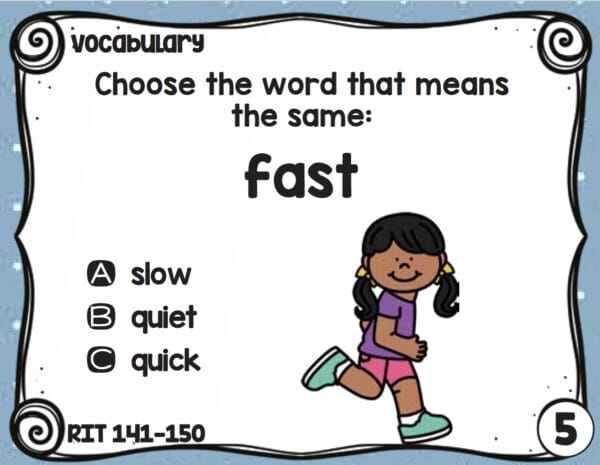
- Identifying and matching synonyms (sleepy, laugh, big, father, little, happy, stones, left, stole, throw)
- Identifying and matching opposites (antonyms)
- Identifying homophones (here, to, blew, roll)
Building a Small Group at RIT 141-150
If you have multiple students in this band, here’s the practical structure for the first month of small group instruction:
Pick ONE priority skill per subject per group
Common high-leverage choices for this band:
- Math: addition facts within 10 (with manipulatives), OR counting and representing sets up to 20, OR analog clock to the nearest hour
- Reading: letter-sound matching, OR blending three sounds to make a word, OR sight word fluency from the band’s target word list
Three weeks of focused practice on one skill produces more growth than three weeks of touching ten skills lightly.
Frequency and duration
Students at RIT 141-150 typically need 5 sessions per week of 10-15 minutes each. Foundational skills at this band are highly cumulative — gaps in one week’s work create deeper gaps in the next. Younger students also have shorter attention spans, so 10-15 minutes more often beats 20+ minutes less often.
Materials
Materials at this band need to be visually clean and developmentally appropriate. For older students working at this band — a 3rd or 4th grader testing here — the additional concern is finding materials that aren’t labeled “Kindergarten” or visually targeted at very young children. That visible labeling can shut down an older student’s engagement before they start.
The RIT Intervention System is built around band-organized materials — every worksheet, task card, and intervention pack is sorted by RIT band rather than grade. That means materials labeled “RIT 141-150” rather than “Kindergarten.” For older students working at this band, the difference is significant.
Where This Band Sits in the Bigger Picture
RIT 141-150 sits one band below RIT 161-170, which represents the next major step in foundational skill consolidation. Students typically progress out of this band into the 151-160 range as letter-sound automaticity develops and addition within 10 becomes fluent.
For the broader band-by-band context, see the math fluency activities by RIT band and reading fluency activities by RIT band overviews. For interpreting the score that puts students at this band, see how to read a MAP report. For the full index of all K-5 RIT bands, see RIT Band Activities.
Stop the guessing game….
When parents and teachers see the same roadmap, everything changes for the child in between.

Free MAP Score Tracker
The score tracker is a one-page-per-class document with columns for fall, winter, and spring scores plus seasonal goal cards. It includes:
- A roster row per student
- Math and reading columns side by side
- Notes space for priority skills and group placement
- Seasonal goal cards for fall, winter, and spring
- A version formatted for MTSS documentation
Drop your email below and the tracker comes to your inbox.
Frequently Asked Questions
What grade level is RIT 145?
RIT scores don’t translate directly to grade levels. RIT 145 is roughly typical for kindergarten students testing in the second half of the year, but the same score means something different for a 1st grader (below the typical range) versus a 3rd grader (well below). The RIT score tells you what skills the student is ready to learn next.
My kindergartener scored RIT 145 — is that good?
For kindergarten testing in winter or spring, RIT 145 is roughly within the typical range. NWEA publishes current grade-level norms — pull the most recent norms document from the NWEA site to compare your child’s score against the percentile, which is the more useful comparison than the RIT number alone.
What’s the best math activity for RIT 145?
The best activity depends on the priority skill you’ve identified. For most groups at this band, the highest-leverage choices are addition facts within 10 (with manipulatives), counting and representing sets up to 20, or analog clock to the nearest hour. Pick one and stay with it for at least three weeks before changing.
My 3rd grader scored RIT 145 — what does that mean?
It means your student is ready to work on skills typical of mid-kindergarten norms. For an older student at this band, this typically reflects significant foundational gaps — the kind that benefit from targeted Tier 3 intervention or special education support. The plan is the same as any band: identify the priority skill, work on it consistently, and monitor with quick probes.
How do I write IEP goals for a student at RIT 145?
Tie the goal to a specific skill at this band, not a target RIT score. “Student will identify all 26 letter sounds with 90% accuracy on a probe by winter testing” is measurable. “Student will reach RIT 155 by winter” is a comparison, not a goal — and it depends on factors outside your control.
How does RIT 141-150 differ from RIT 161-170?
RIT 141-150 focuses on foundational letter-sound matching, sight words in the kindergarten range, and addition with manipulatives within 10. RIT 161-170 shifts toward blending sounds fluently, sight words from the 1st-grade range, and decomposing numbers within 10 — the skills that bridge from “learning letters” to “reading words.”
What if my student is at RIT 149 — should I push toward 151-160 skills?
Students at the upper edge of a band can often start working on the next band’s skills, particularly in their stronger domains. Counting forward by 5s within 100 (a 151-160 skill) builds on the counting and representing sets work students do in 141-150.
How often should I retest students at this band?
The full MAP test runs three times a year — fall, winter, spring. Don’t retest the full MAP between windows. Use quick skill-specific probes every 2 weeks to monitor progress on your priority skill. For young students at this band, a probe might be as simple as showing 10 letter-sound flashcards and recording how many they get right.
Save This for Planning
Pin this so you have the band-specific skills handy each time you’re building small groups — fall, winter, or spring.
Final Thoughts
RIT 141-150 is the foundational band where kindergarten on-grade students overlap with older students in significant intervention. Same band, three contexts (K-1 on-level, intervention students), identical instructional needs. Pick one priority skill per subject. Run 5 short sessions a week given how cumulative early skills are. Monitor with quick probes, not full retests. By winter MAP, you’ll have weeks of practice notes and a clear picture of who’s ready to move up to the next band.