The Months of the Year: Learning Months in Order
Have you ever wondered why we have 12 months in a year?
It’s not random—it’s the result of thousands of years of people studying the sky, the seasons, and how the Earth moves around the sun.
Our modern calendar, called the Gregorian calendar, helps us keep track of time so that holidays, seasons, and even the start of school happen when they should.
The 12 Months in Order
| # | Month | Days | Abbreviation | Quarter | Season (Northern Hemisphere) |
|---|---|---|---|---|---|
| 1 | January | 31 | Jan. | Q1 | Winter |
| 2 | February | 28 (29 in leap years) | Feb. | Q1 | Winter |
| 3 | March | 31 | Mar. | Q1 | Spring |
| 4 | April | 30 | Apr. | Q2 | Spring |
| 5 | May | 31 | May | Q2 | Spring |
| 6 | June | 30 | Jun. | Q2 | Summer |
| 7 | July | 31 | Jul. | Q3 | Summer |
| 8 | August | 31 | Aug. | Q3 | Summer |
| 9 | September | 30 | Sep. | Q3 | Fall |
| 10 | October | 31 | Oct. | Q4 | Fall |
| 11 | November | 30 | Nov. | Q4 | Fall |
| 12 | December | 31 | Dec. | Q4 | Winter |
Each month marks a special part of our trip around the sun—winter’s chill, spring’s renewal, summer’s warmth, and fall’s color. The pattern keeps repeating, just like the seasons.

How Many Months in a Year?
There are 12 months in a year, and that never changes.
The calendar divides our year into smaller chunks of time that help us plan everything—school schedules, planting seasons, birthdays, and holidays.
How Many Days in Each Month?
Not all months are created equal. Some have 30 days, others have 31—and February keeps us guessing with 28 or 29.
31 days: January, March, May, July, August, October, December
30 days: April, June, September, November
28 or 29 days: February
A simple rhyme can help you remember:
Thirty days has September,
April, June, and November.
All the rest have thirty-one,
Except for February alone.
With twenty-eight days clear,
And twenty-nine in each leap year.
What Is a Leap Year?
Every four years, we add an extra day to February.
Why? Because the Earth doesn’t take exactly 365 days to orbit the sun—it takes about 365¼ days. Without that extra day every few years, our seasons would slowly drift. Imagine celebrating New Year’s in summer!
Leap years include: 2024, 2028, 2032, and 2036.
To check if a year is a leap year:
- If it divides evenly by 4, it’s a leap year.
- But if it’s a century year (like 1900), it must also divide evenly by 400.
The Longest and Shortest Days
- Longest Day: Around June 20 (Summer Solstice) – when we have the most daylight hours.
- Shortest Day: Around December 21 (Winter Solstice) – when daylight is at its shortest.
These special days mark the turning points of the seasons.

A Closer Look at Each Month
January – The first month of the year, named after Janus, the Roman god of beginnings.
February – Named for Februa, a Roman festival of cleansing and renewal.
March – Named after Mars, the Roman god of war.
April – Believed to come from aperire, meaning “to open,” like flowers in spring.
May – Honors Maia, the goddess of growth.
June – Named for Juno, the Roman goddess of marriage and family.
July – Honors Julius Caesar.
August – Named for Augustus, Rome’s first emperor.
September – Comes from septem, meaning seven.
October – Comes from octo, meaning eight.
November – Comes from novem, meaning nine.
December – Comes from decem, meaning ten.
Why do the last four names seem off? Because long ago, the Roman calendar only had ten months—March through December. January and February were added later to make twelve.
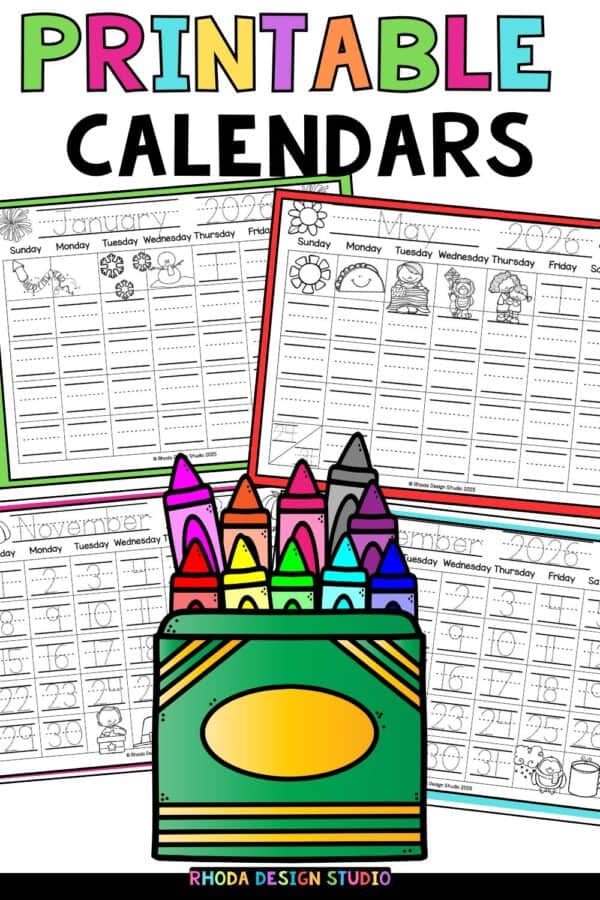
How the Calendar Evolved
The Roman Calendar began with ten months.
The Julian Calendar, created by Julius Caesar, added leap years and gave us 365¼ days.
The Gregorian Calendar, introduced by Pope Gregory XIII in 1582, fine-tuned that system to match the Earth’s true orbit. That’s the one we use today.
The Moon and the Months
The word “month” comes from mensis, the Latin word for “moon.”
Early calendars followed the moon’s cycle—from new moon to full moon—about 29½ days. This is called a lunar month. Over time, calendars were adjusted to match both the moon and the sun, which is why we now follow a solar calendar.
Why This Matters
Learning about the months isn’t just about memorizing names—it’s about understanding how people learned to track time, plant crops, plan holidays, and celebrate the rhythm of the seasons.
Whether you’re teaching calendar skills, creating a classroom chart, or helping your child learn the months, this knowledge connects history, science, and everyday life.