Math Fluency Activities for NWEA RIT Bands 121-230
If you’ve got MAP scores in hand and you’re trying to figure out what each child needs to practice next in math, this is the post for that. You’ll find math fluency activities sorted by RIT band from 121 through 230, plus a free sample worksheet set at the bottom that’s built around the same band structure.
The whole point of organizing math practice by RIT band instead of by grade is that two students in the same grade can be eighty points apart on MAP, and they don’t need the same problems. A band-by-band approach lets you pull a small group, hand each kid the right level, and stop guessing.
Why Math Fluency Matters for MAP Growth
Fluency is the bridge between procedure and problem-solving. A student who’s still computing every basic fact can’t hold the structure of a word problem in their head, and that shows up directly on MAP. The Math test is timed and dense, and students who calculate slowly run out of working memory before they reach the answer.
Targeted fluency practice helps because it:
- Frees up working memory so kids can focus on the structure of a problem, not just the calculation
- Builds the automaticity that MAP Math rewards across operations and word problems
- Gives you something specific to track week to week instead of waiting for the next testing window
- Closes gaps without piling on more worksheets that aren’t matched to the right level
Stop the guessing game….
When parents and teachers see the same roadmap, everything changes for the child in between.

What Are RIT Bands in Math?
RIT stands for Rasch Unit. The score is a measure of what a student is ready to learn next, not where they sit relative to a grade. Two third-graders can land at RIT 165 and RIT 215 on the same MAP Math test, and that gap means they need different math practice on Monday morning.
Bands are just ten-point chunks of the RIT scale. Sorting your students into bands is the fastest way to plan small groups, intervention blocks, and centers without guessing.
Common Math RIT Bands in K-5:
- 121-140: Pre-numeracy and emerging numeracy. Counting with meaning, numeral recognition, basic shapes, one-to-one correspondence.
- 141-170: Number sequencing within 20, addition and subtraction within 10, simple story problems, beginning ten-frame work.
- 171-200: Addition and subtraction within 20 and 100, place value to two digits, basic measurement and time, fact fluency building.
- 201-230: Regrouping with two and three digits, multi-step word problems, multiplication and division basics, simple fractions.
If you’re already running math centers or intervention groups, you’ve done the hard part. The RIT band gives you the exact zone of growth for each child so the practice you assign actually moves the needle.
How to Find Your Student’s RIT Band on the MAP Report
If you’ve never pulled a band off a MAP report before, here’s the quick version.
Open the Student Profile report or the Class Roster report in your NWEA dashboard. The big number near the top of each student’s row is the RIT score. That’s the one you want.
To find the band, round the RIT score down to the nearest ten. A student with a 167 is in the 161-170 band. A student with a 184 is in the 181-190 band. The Learning Continuum that NWEA provides splits its skill suggestions into ten-point bands too, which is why this matches up.
If you want to track multiple students at a glance, the free NWEA score tracker on this site is built for exactly that. Print one page per testing window and you’ve got fall, winter, and spring side by side.
Math Fluency Activities by RIT Band
What follows is the band-by-band breakdown. Each section gives you four activities you can run in a small group, a math center, or a one-on-one intervention, plus an instructional tip and a worksheet sample. Pick the band that matches your student’s MAP RIT score and start there.
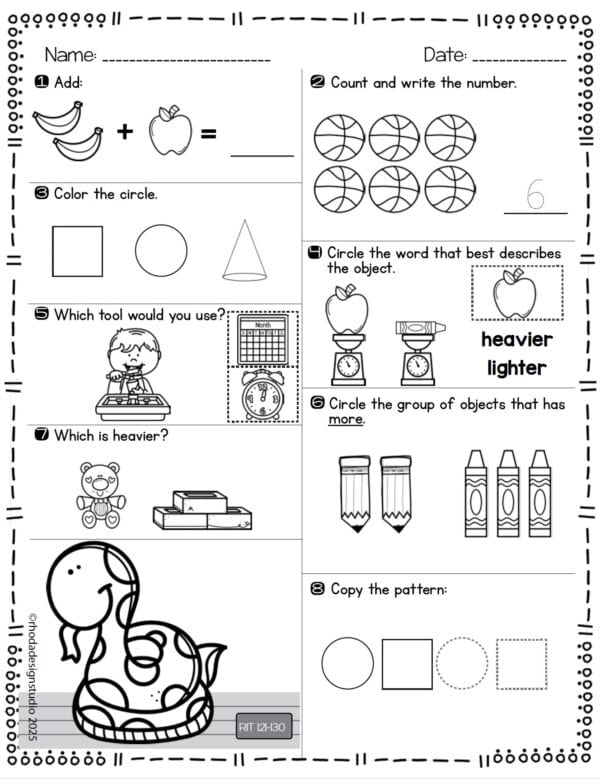
RIT Band 121-130: Pre-Numeracy
Students in this band are still building the foundation. They’re learning that numbers represent quantities, that counting has order, and that shapes and patterns are predictable. Most of the practice here is hands-on and oral, with a small amount of print exposure.
- Counting Collections: A small bowl of objects (buttons, beans, mini erasers). Count them out loud, then count them again. Builds one-to-one correspondence and stable counting order.
- Numeral-to-Quantity Match: Cards showing 1 through 10. Match a numeral to a set of dots or pictures. The match is the reinforcement.
- Shape Hunts: Find circles, squares, triangles, and rectangles around the room. Builds shape recognition and the language to name them.
- Counting Songs and Movement: Five Little Ducks, count-by-ones while jumping, count backwards from ten. Movement plus counting locks in the sequence.
Instructional Tip: Keep sessions short and physical. The goal is for counting to feel automatic before any worksheet asks them to write the answer.
Math RIT 121-130
RIT Band 131-140: Early Numeracy
Students here can count reliably to ten or twenty and recognize most numerals. They’re starting to understand that numbers can be combined and separated, and they’re ready for early addition and subtraction with concrete objects.
- Dot Card Subitizing: Quick flashes of dot patterns up to six. Say the total without counting. Builds the visual number sense that everything else rests on.
- Number Line Hops: A large floor number line. Hop forward two, hop back one. The body learns addition and subtraction before the worksheet does.
- Counting On from a Number: Hide some objects in a cup, show two more. Start at the hidden number and count up. Critical for moving past count-all addition.
- Compare and Order Cards: Two number cards, which is bigger? Three cards, put them in order. Builds magnitude understanding.
Instructional Tip: Pair every numeral with a quantity they can see or touch. Abstract math is a long way off.

Math RIT 131-140

Math RIT 141-150
RIT Band 141-160: Number Sequencing and Addition Within 10
By this band, students can count to twenty or beyond, recognize numerals, and combine small quantities with manipulatives. The work now is moving them from concrete addition (with objects) to representational addition (with pictures and ten frames) so that abstract symbols come next.
- Ten Frame Fluency: Fill and empty ten frames to show numbers from 1 to 10. Builds the part-whole thinking that anchors addition and subtraction.
- Roll and Solve: Two dice, roll, write the addition sentence, find the sum. Quick, low-prep, repeatable for years.
- Picture Story Problems: “There are 3 apples. 2 more are added. How many?” Pictures first, numbers second. Builds the meaning behind the operation.
- Number Bond Builders: Part-part-whole circles. Show 5 broken into 3 and 2. Then 1 and 4. Then 0 and 5. Foundation for fact families.
Instructional Tip: Encourage students to explain how they got the answer. The verbal explanation is what cements the math.

Math RIT 151-160

Math RIT 161-170
RIT Band 161-180: Addition and Subtraction Within 20
Students in this band can add and subtract within 10 and are working toward fluency within 20. They’re starting to recognize doubles, near-doubles, and make-ten strategies. Most of these students are first or second grade, but you’ll see third graders here too if they’re getting intervention support.
- Doubles and Near-Doubles Practice: 6 + 6, then 6 + 7. The doubles are the anchor, the near-doubles are the strategy. Big leverage for fact fluency.
- Make-Ten Cards: 8 + 5 becomes 8 + 2 + 3. Students decompose the second number to make ten first. Cards with the missing piece highlighted help.
- Flash Card Self-Races: Twenty cards, time yourself, beat last week. The kid competes against their own past self, not a classmate.
- Two-Step Story Problems: “Mia had 8 stickers. She gave 3 to her brother. Then her mom gave her 5 more. How many now?” Builds the working memory that MAP word problems demand.
Instructional Tip: Fluency without strategy is memorization. Strategy without fluency is slow. You want both.

Math RIT 171-180

Math RIT 181-190
RIT Band 181-200: Place Value and Two-Digit Operations
Students here can fluently add and subtract within 20 and are starting to work with two-digit numbers. The work now is place value, mental math with bigger numbers, and the early bridges to multiplication through skip counting.
- Place Value Decomposition: 47 = 40 + 7. 256 = 200 + 50 + 6. Then put it back together. Builds the understanding that regrouping later depends on.
- Skip Counting Ladders: Count by 2s, 5s, and 10s up and down. The bridge from addition fluency to multiplication. Run as a chant, run as a worksheet, run with a number line.
- Mental Math with Tens: 30 + 40. 80 minus 50. Train students to see the tens, do the math, then add the digit. Saves time on every two-digit problem they’ll ever do.
- Number Bingo (Two-Digit): Sums and differences to 50 or 100. Five in a row wins. Cheap, fast, kids love it.
Instructional Tip: Skip counting isn’t just a chant. It’s the foundation for multiplication, division, and ratios. Treat it like the high-leverage skill it is.

Math RIT 191-200

Math RIT 201-210
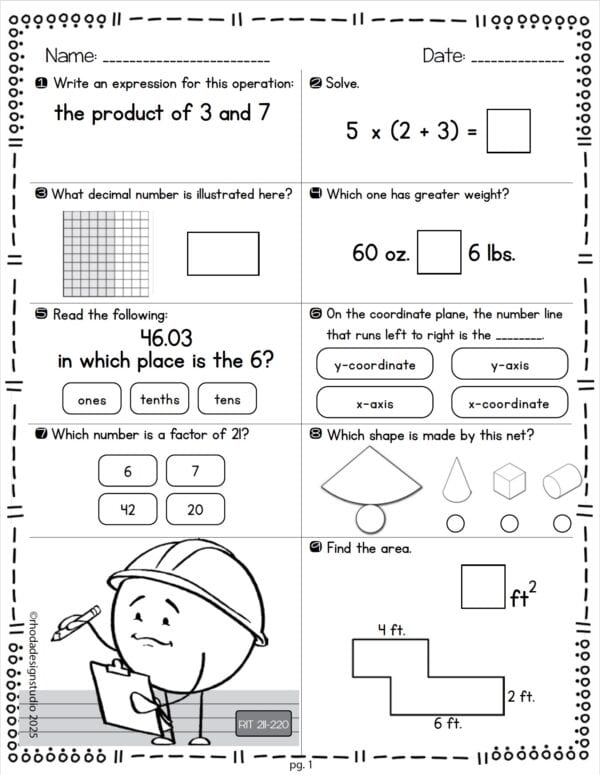
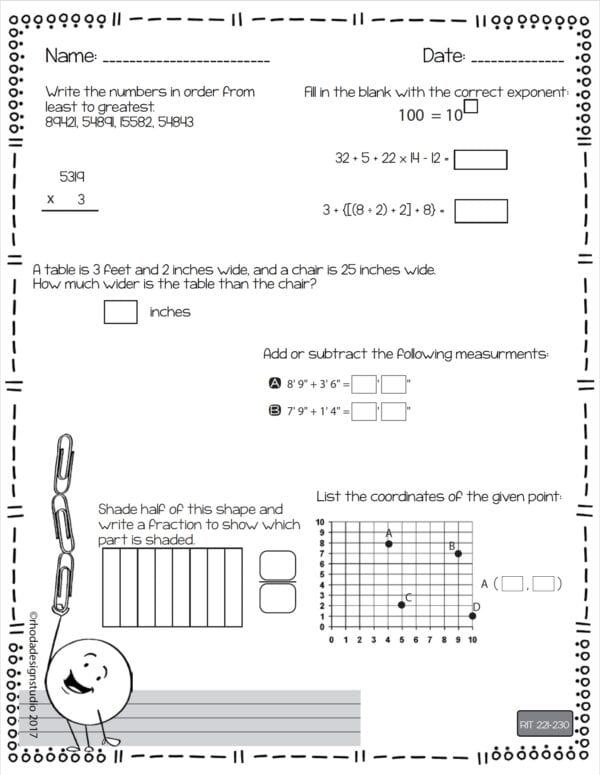
RIT Band 201-230: Multi-Step Thinking and Multiplicative Reasoning
By this band, students have fluent addition and subtraction. The work moves to multiplication, division, fractions, and the multi-step word problems that MAP loves to assess. Fluency now means recognizing patterns and choosing the right operation, not just calculating fast.
- Array Building: Use grid paper or tiles to build 3 by 4, 5 by 2, 6 by 3. The visual is the bridge from addition to multiplication.
- Fact Family Triangles: One triangle, three numbers (3, 4, 12). Students write all four facts: 3 x 4 = 12, 4 x 3 = 12, 12 ÷ 3 = 4, 12 ÷ 4 = 3. Cements the inverse relationship.
- Fraction Strips and Visuals: Match 1/2 to a half-shaded shape. Match 1/4 to a quarter. Compare 1/3 and 1/2 visually before any number talk.
- Multi-Step Word Problem Sort: Cards with one-step and two-step word problems mixed together. Students sort first, then solve. Builds the habit of reading for structure.
Instructional Tip: Pair fluency work with conceptual models like arrays and number lines. Procedure plus picture is what stays.
Math RIT 211-220
Math RIT 221-230
Using MAP Data to Plan Your Math Groups
Once you’ve got MAP RIT scores in hand, the planning work goes faster than most teachers expect. The trick is to stop sorting by grade and start sorting by band.
A workable weekly setup looks like this:
- Sort your roster by RIT score, low to high
- Group students whose scores fall within twenty points of each other
- Pull the matching band activities from above for each group
- Run fluency in ten to fifteen minute blocks, three to five times a week
- Track facts correct per minute or activity completion in the same notebook so you can see growth without rebuilding the system every Monday
This is the same approach interventionists use in pull-out groups, and it works in a regular classroom too. Once the bands are set, the planning is mostly done.
Common Reasons Math Fluency Stalls (And What to Do)
If you’ve been running fluency practice for a few weeks and the RIT score isn’t moving, the issue is usually one of these.
The numbers are too big. Fluency practice works in the just-right zone. If a student is struggling with addition within 20, drop to within 10 for a week. The fluency that comes back is what holds when you go back up.
The numbers are too small. The opposite problem. If a student is breezing through addition within 10 with no errors and no growth in speed, they’re maintaining what they already had. Move up a band’s worth of math and see what happens.
Strategy is missing. Some students memorize facts without understanding the relationships. They get the doubles but freeze on near-doubles. They get count-on but can’t make ten. Pause the speed work and teach one strategy explicitly. Speed comes back faster once the strategy is in place.
Number sense hasn’t caught up. A student stuck below RIT 160 who’s getting timed addition drills is being asked to run before they walk. Pause the fluency block and put a week of pure number-sense work in front of them, things like ten frames, dot cards, and number lines.
The practice isn’t frequent enough. Math fluency is a habit. Two minutes a day for two weeks beats fifteen minutes once a week. If you can’t find daily time, three sessions a week is the floor.
Frequently Asked Questions About Math RIT Bands
What is a RIT band in MAP Math?
A RIT band is a ten-point chunk of the Rasch Unit scale that NWEA uses to score MAP. The bands sort students by what they’re ready to learn next, not by grade level. A second-grader and a fourth-grader can be in the same RIT band if they’re working on similar math skills.
What’s a typical math RIT score by grade?
Approximate fall RIT means in MAP Math run roughly: kindergarten 140, first grade 160, second grade 177, third grade 191, fourth grade 203, fifth grade 213. These are averages, not targets. A child five points below the mean isn’t behind, and a child five points above isn’t done growing.
How do I know my student’s RIT band?
Pull up the MAP Growth report for the student. The RIT score is the big number near the top. Round it to the nearest ten and you’ve got the band. A student who scored 187 is in the 181-190 band.
How often should I run math fluency practice?
Three to five short sessions a week works better than one long one. Ten to fifteen minutes is enough for the practice to stick without burning out the student. Daily is the gold standard for kids in lower bands or active intervention.
Can I use these activities for homeschool?
Yes. The band system works the same whether you’re running a small group or sitting at the kitchen table with one child. If you’re not testing with MAP, you can use a recent math assessment to estimate the band and adjust as you go.
What’s the difference between math fluency and number sense?
Number sense is the understanding of how numbers work and how they relate. Math fluency is the speed and accuracy with which a student can use that understanding. Fluency without number sense is fragile memorization. Number sense without fluency is slow problem-solving. The goal is both, and that’s why the activities here pair the two.
Free Math Fluency Sample Worksheets by RIT Band
If you want a head start, grab the free sample set. Ten worksheets, one per RIT band from 121 through 230, ready to print and use in your next small group.
Each worksheet includes:
- One-step or multi-step fluency practice matched to the band
- A simple student-friendly self-check
- A teacher tracker box for facts correct per minute or activity completion
- Visual support for conceptual learning across all bands
Drop your email below and the set will land in your inbox.
Save This Post for Later
Pin it to your math intervention or math centers board so it’s there when your next planning block hits.

Final Thoughts
Math fluency isn’t a single skill. It’s a stack of skills that change depending on where the student is on the RIT scale. Pre-numeracy students in the 121-130 band need counting and one-to-one work. Students in the 201-230 band need multi-step word problems and multiplicative thinking. The activity that helps one will not help the other, and that’s the whole point of organizing this way.
Pick the band that matches your student’s MAP RIT score. Run the activities. Track the growth. Adjust as the next testing window confirms what you already saw in the small group.
If you teach reading too, the matching reading fluency activities by RIT band post is built the same way. Same band logic, applied to reading.
Got a question about a specific band, a tricky student, or how to fit fluency into a packed schedule? Drop it in the comments. I read every one.