RIT 221-230 Activities: What to Teach Math and Reading at This Band
Your student tested at RIT 225. Maybe RIT 228. Somewhere in the 221-230 band — the upper edge of NWEA’s K-5 band coverage. This is gifted-level upper-elementary territory or middle-school on-level territory, depending on the grade. Now you need to figure out what to actually teach them this week.
This post is the answer for the 221-230 band specifically. Math AND reading skills broken down to what students at this band are ready to learn next, with activity ideas you can pull tomorrow morning. Built for K-5 teachers and interventionists who already know how to teach and just need the band-by-skill bridge.
The free score tracker linked at the bottom is what most teachers use to keep their group rosters and priority skills straight all year. Grab it before you start planning.
Who’s at RIT 221-230?
This band typically captures two distinct student groups:
- Above-grade-level 4th and 5th graders. Students testing here in upper elementary are working above their grade-level peers, often candidates for enrichment, gifted programming, or accelerated curriculum.
- On-grade-level 6th-8th graders. Middle school norms typically land in this band, so students testing here in 6th-8th grade are exactly where they’re expected to be.
The same RIT band, two very different planning contexts. For the upper-elementary teacher, this band is about extension and depth. For the middle school teacher or interventionist, it’s about consolidating on-grade work. The skills are identical regardless of grade.
Math Skills at RIT 221-230
Math at this band is genuinely lean — not because there’s less to teach, but because students are working at the level where most operations are applied within complex problems rather than practiced in isolation. The new content is concentrated in 3D geometry and cross-sections.
Operations & Algebraic Thinking
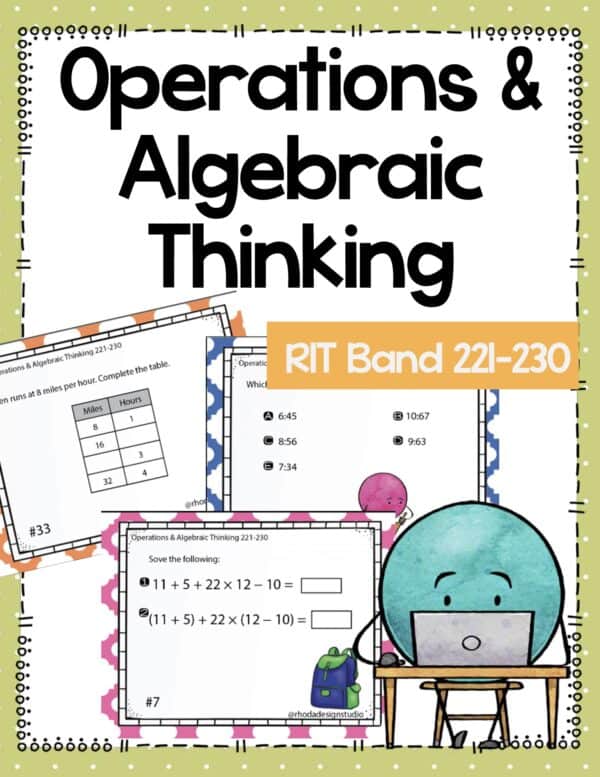
- Representing division word problems with an equation (2-digit dividend, 1-digit divisor; quotient less than 10)
- Solving multi-step word problems
Activity ideas for Operations
- Multi-step problem creation — students write their own multi-step problems based on real-world scenarios (event budgets, construction estimates, sports statistics) and trade with partners to solve
- Strategy comparison challenges — students solve the same complex problem multiple ways and explain which strategy was most efficient AND which was most generalizable
- Reverse engineering equations — given an equation with a variable, students write a word problem that fits it, then solve
Number & Operations
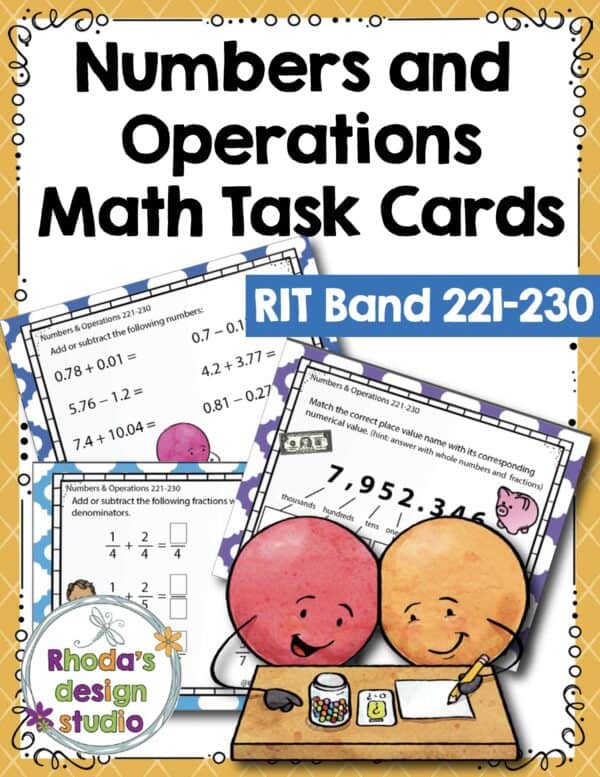
- Determining basic division facts (quotient less than 5, long division symbol)
- Determining the quotient (less than 100, 2-digit dividend and 1-digit divisor)
Measurement & Data
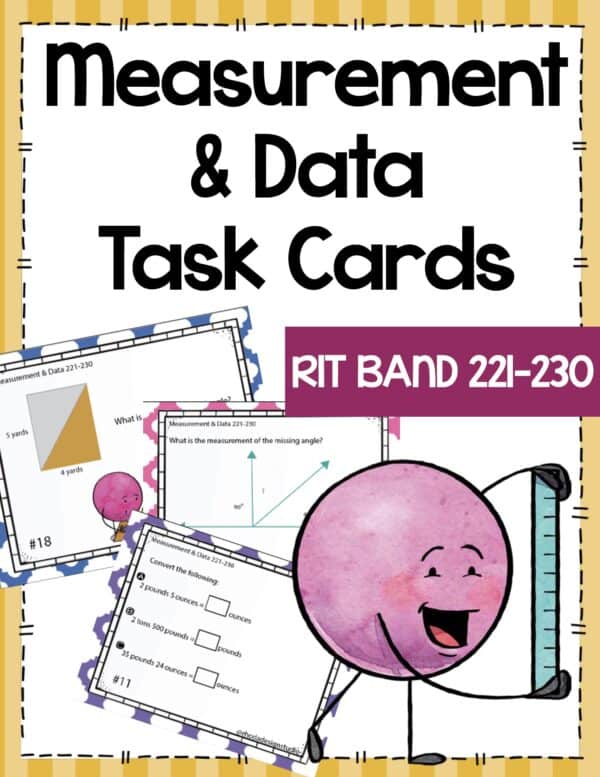
- Determining the perimeter of a rectangle (non-standard units)
Geometry
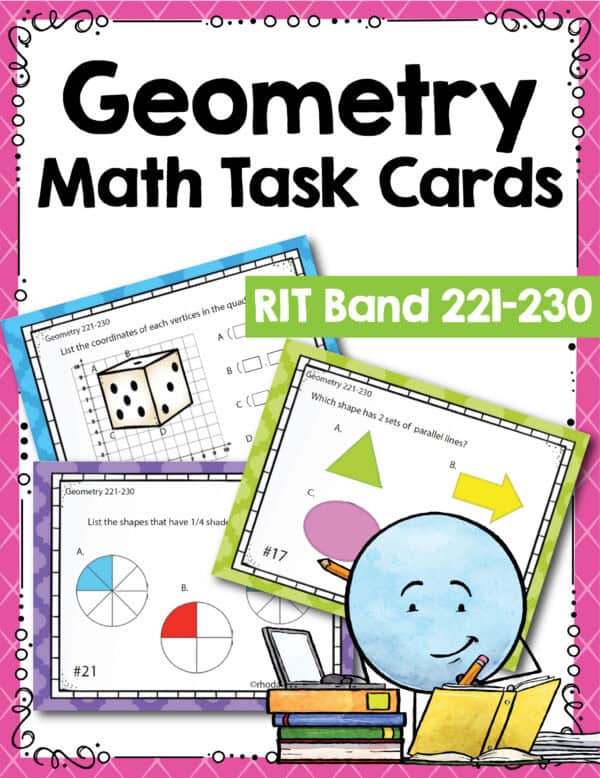
Geometry is the densest math content at this band, with formal 3D content and cross-section analysis:
- Identifying and creating nets for prisms (continuing from 211-220)
- Identifying the cross-sections of 3-D shapes (NEW at this band)
- Recognizing that the sum of the interior angles of a triangle is 180 degrees
Activity ideas for Geometry
- Cross-section drawing practice — students draw what the cross-section of a cylinder, cone, sphere, and rectangular prism would look like when sliced horizontally and vertically
- Play-Doh slicing demonstrations — students mold 3D shapes from clay and physically slice them to see the actual cross-sections, then sketch what they see
- 3D net cutout activities — students cut and fold paper nets into prisms; for upper-band students, challenge them to create their own original nets and verify they fold correctly
- Triangle angle proofs — students measure angles in various triangles and verify the 180-degree sum, then explain why this is always true (informal proof writing)
Reading and Language Skills at RIT 221-230
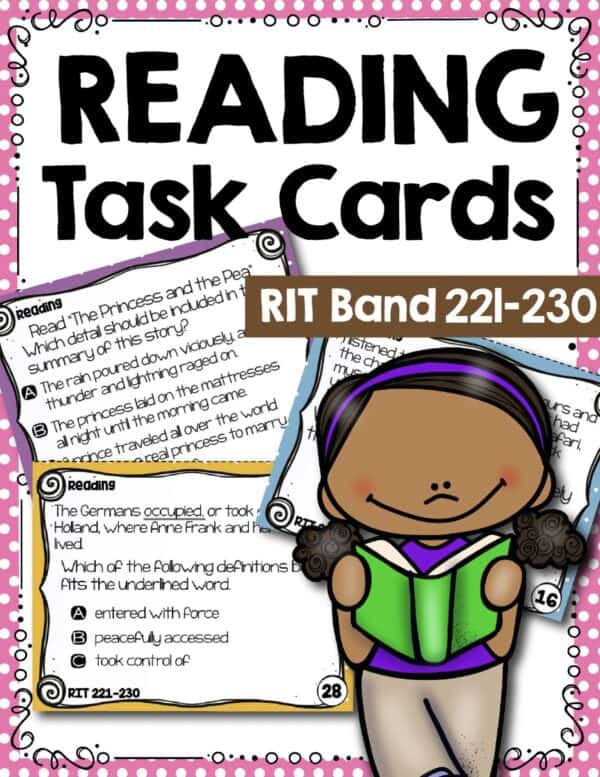
Reading at this band is the most analytical of any K-5 band. There’s no phonics content and no grammar conventions in isolation — students at this level are expected to apply both fluently. The remaining work is in deep literary analysis: how narrators shape what readers experience, how dramatic structure (soliloquy, sonnet) contributes to meaning, and how multiple texts compare in their structure.
Phonics & Foundational Skills
The CCSS data shows no phonics content at this band — confirming the pattern that began at 211-220. Students at this RIT level have fully consolidated decoding. Students still working on phonics here need targeted intervention focused on the specific decoding gap, not band-level instruction.
Reading Literature
- Describing how a narrator’s or speaker’s point of view influences how events are described
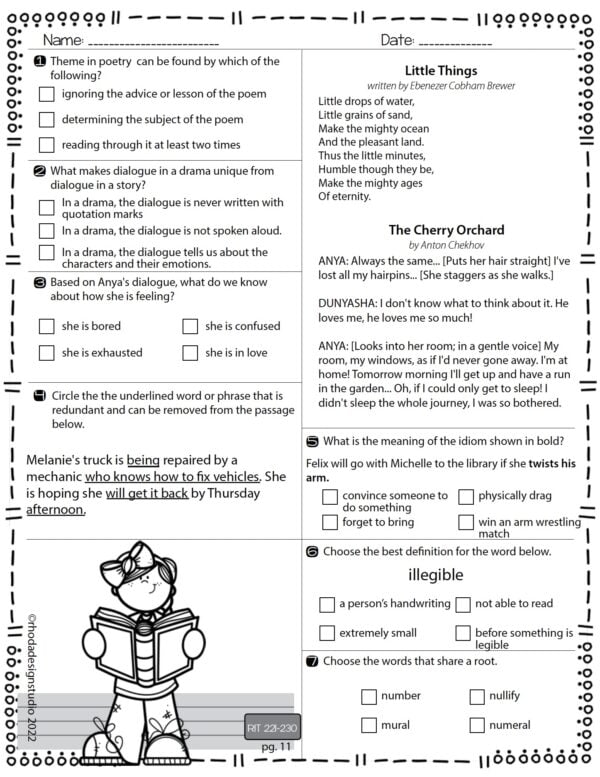
- Analyzing how a drama’s or poem’s form or structure (soliloquy, sonnet) contributes to its meaning
- Analyzing how differences in the points of view of the characters and the audience or reader create such effects as suspense or humor
Reading Informational Text
- Explaining how an author uses reasons and evidence to support particular points in a text
- Comparing and contrasting the overall structure of events, ideas, concepts, or information in two or more texts
- Analyzing how a text makes connections among and distinctions between individuals, ideas, or events
Activity ideas for Reading Comprehension
- Narrator perspective rewrites — given a short story passage, students rewrite the same scene from a different character’s point of view and analyze how the events feel different
- Dramatic irony identification — students read short scenes where the audience knows something the character doesn’t, and explain how that knowledge creates suspense or humor
- Soliloquy and sonnet analysis — students read a brief Shakespearean soliloquy or a sonnet and analyze how the form (structure of lines, where the volta turns) contributes to the meaning
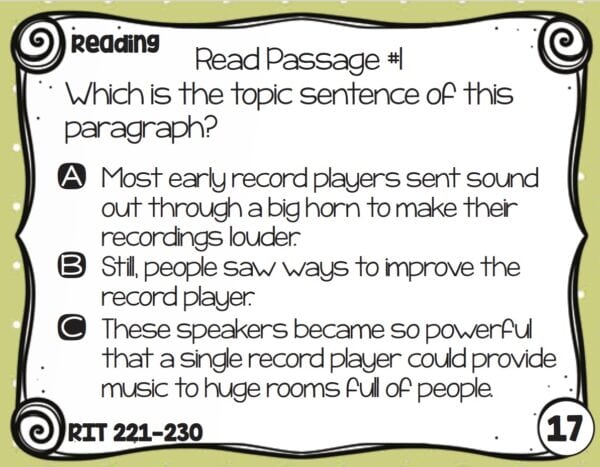
- Two-text structure comparisons — students read two short texts on the same topic and compare their structures (one chronological, one cause-and-effect) and explain how each structure changes the reader’s understanding
- Author’s reasoning maps — students identify the central claim of an argumentative text, then map the reasons and evidence the author uses to support it, evaluating which reasons are strongest
Language Arts
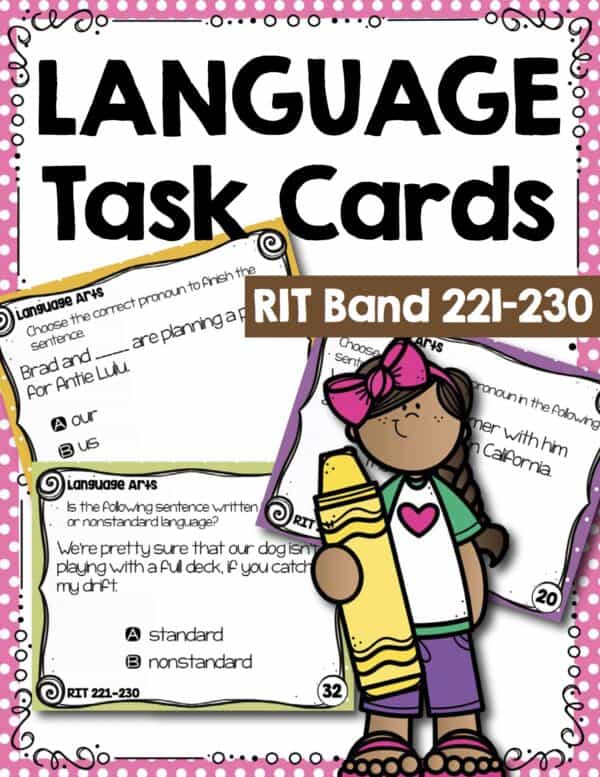
The CCSS data shows no language arts content listed in isolation at this band. Grammar conventions are now fully expected to be applied within writing and analytical reading rather than practiced separately. Students still working on sentence-level grammar at this band need targeted intervention rather than band-level instruction.
Vocabulary
- Consulting reference materials to find pronunciation and clarify precise meaning of key words and phrases
- Interpreting figurative language, including similes and metaphors, in context
- Using the relationship between particular words (synonyms, antonyms, homographs) to better understand each of the words
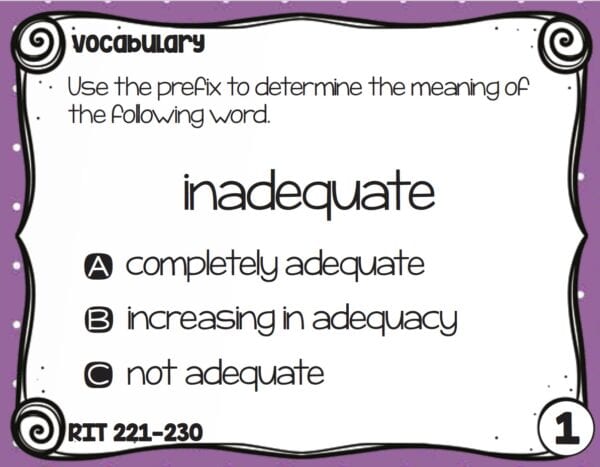
Activity ideas for Vocabulary
- Homograph clarification practice — given a word with multiple meanings (bat, lead, bow), students write sentences that clearly establish each meaning
- Figurative language interpretation in context — students read short passages with similes or metaphors and explain not just what the comparison is but WHY the author chose that comparison specifically
- Synonym/antonym shade-of-meaning practice — given a word, students rank its synonyms by intensity (e.g., warm → hot → scorching → blazing) and discuss when each one fits
Building a Small Group at RIT 221-230
If you have multiple students in this band, here’s the practical structure for the first month of small group instruction:
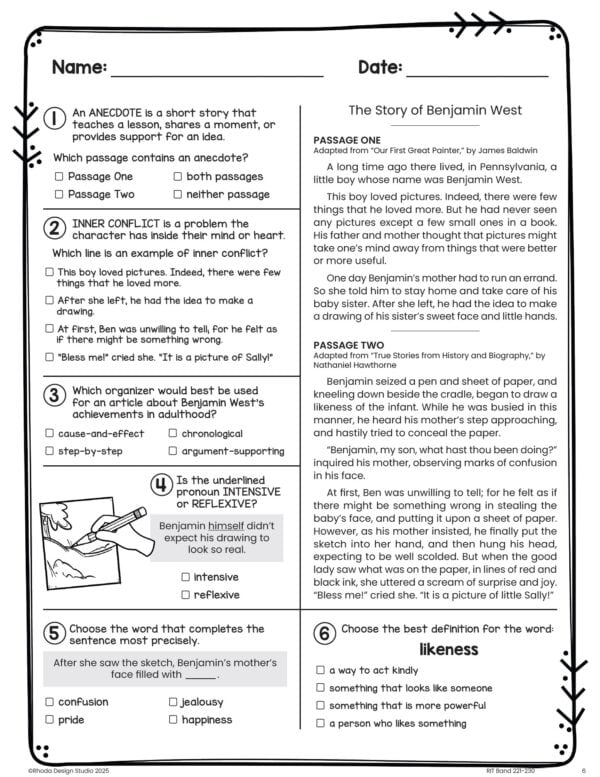
Pick ONE priority skill per subject per group
Common high-leverage choices for this band:
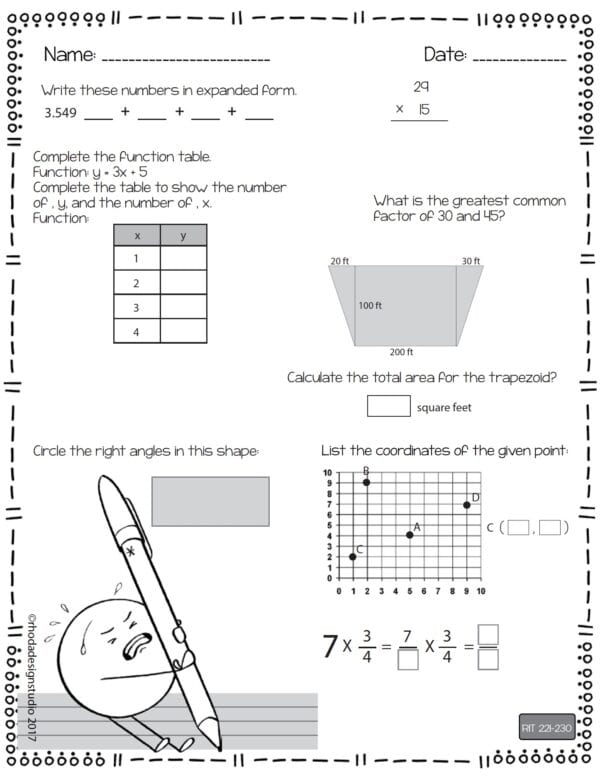
- Math: cross-sections of 3-D shapes (genuinely new content at this band), OR multi-step word problem creation, OR perimeter problems involving variables
- Reading: narrator influence on event description, OR comparing structure across two or more texts, OR analyzing point-of-view differences for suspense or humor effects
Three weeks of focused practice on one skill produces more measurable growth than three weeks of touching ten skills lightly.
Frequency and duration
Students at RIT 221-230 typically need 2 sessions per week of 30 minutes each. The analytical work at this band — narrator analysis, dramatic irony identification, cross-section visualization — requires uninterrupted thinking time. Most students at this band can sustain longer sessions and will gain more from depth than from frequency.
Materials
Materials at this band need to feel age-appropriate for middle schoolers (since 6th-8th graders on grade level test here) AND offer enough analytical depth to challenge above-grade upper-elementary students. The dual audience makes “right material” harder than at any band below.
The RIT Intervention System is built around band-organized materials — every worksheet, task card, and intervention pack is sorted by RIT band rather than grade. Materials labeled “RIT 221-230” rather than “5th grade enrichment” or “6th grade core” sidesteps the engagement and labeling issues that come with serving a dual upper-elementary and middle-school audience.
Stop the guessing game….
When parents and teachers see the same roadmap, everything changes for the child in between.

Where This Band Sits in the Bigger Picture
RIT 221-230 is the upper edge of NWEA’s K-5 band coverage. Students testing above 230 are working at content levels typically considered middle school or higher and may benefit from grade-level acceleration or advanced curricular options beyond what band-based intervention typically offers.
For students who haven’t yet consolidated the prerequisite skills from this band, see RIT 211-220 activities for the foundational long division, point-of-view comparison, and 3D geometry work that sets up 221-230 success.
For the broader band-by-band context, see the math fluency activities by RIT band and reading fluency activities by RIT band overviews. For interpreting the score that puts students at this band, see how to read a MAP report. For the full index of all K-5 RIT bands, see RIT Band Activities.
Free MAP Score Tracker
The score tracker is a one-page-per-class document with columns for fall, winter, and spring scores plus seasonal goal cards. It includes:
- A roster row per student
- Math and reading columns side by side
- Notes space for priority skills and group placement
- Seasonal goal cards for fall, winter, and spring
- A version formatted for MTSS documentation
Drop your email below and the tracker comes to your inbox.
Frequently Asked Questions
What grade level is RIT 225?
RIT scores don’t translate directly to grade levels. RIT 225 is roughly the fall norm for 6th-7th graders in many recent NWEA samples, but the same score means something different for a 4th grader (well above the typical range) versus a 9th grader (below). The RIT score tells you what skills the student is ready to learn next.
My 5th grader scored RIT 225 — what does that mean?
It means your student is working above the typical range for 5th graders and is ready for content typical of 6th-7th grade norms. This often indicates a candidate for enrichment, gifted programming, or accelerated curriculum. The plan shifts from “filling gaps” to “providing depth and challenge” — the same kind of small-group work, but with extension activities rather than remediation.
What’s the best math activity for RIT 225?
The best activity depends on the priority skill you’ve identified. For most groups at this band, the highest-leverage choices are cross-sections of 3D shapes (genuinely new content at this band), multi-step word problem creation (where students write their own problems), or 3D net design challenges.
Why is the math content list so short for this band?
Because students at this band APPLY operations within complex problems rather than practicing them in isolation. The shorter list reflects developmental reality — most procedural math work has consolidated by this band, and the new content is concentrated in 3D geometry and multi-step problem application. Don’t pad the practice; instead, embed operations within rich problem contexts.
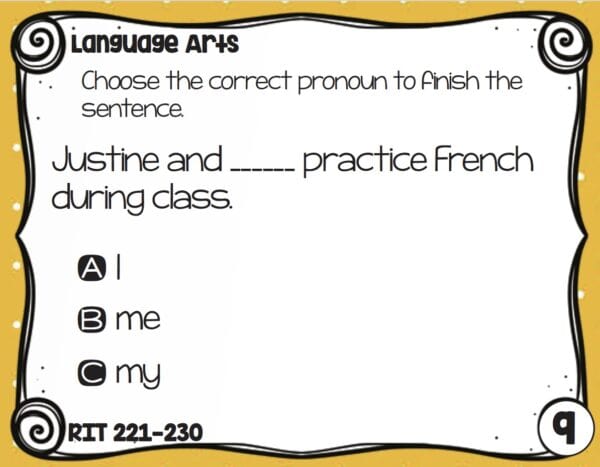
How does RIT 221-230 differ from RIT 211-220?
RIT 211-220 introduces long division as a formal procedure, basic 3D nets, and Greek and Latin roots. RIT 221-230 shifts toward cross-sections of 3D shapes, narrator influence on event description, and dramatic irony analysis. The math content at 221-230 is genuinely lighter; the reading content shifts from “comparing” point of view to “analyzing how point of view shapes meaning.”
Should an above-grade-level upper-elementary student do this band’s work?
Yes — this is exactly what this band is designed for. A 4th or 5th grader testing at RIT 225 is ready for content typical of 6th-7th grade norms. Small group work at this band level provides appropriate enrichment without the social complications of moving the student to a higher grade for instruction.
How do I write IEP goals for a student at RIT 225?
Tie the goal to a specific skill at this band, not a target RIT score. “Student will identify and draw cross-sections of 4 different 3-D shapes with 80% accuracy on a probe by winter testing” is measurable. “Student will reach RIT 235 by winter” is a comparison, not a goal — and it depends on factors outside your control.
What’s beyond RIT 230?
Students testing above RIT 230 are typically working at content levels considered middle school or higher. NWEA’s K-5 norm samples don’t extend much above this band. For students consistently testing above 230, the conversation shifts from band-based intervention to grade-level acceleration, advanced course placement, or specialized gifted programming.
Save This for Planning
Pin this so you have the band-specific skills handy each time you’re building small groups — fall, winter, or spring.
Final Thoughts
RIT 221-230 is the upper edge of NWEA’s K-5 band coverage — where above-grade upper-elementary students overlap with on-grade middle schoolers. Same band, two contexts, identical instructional needs. Pick one priority skill per subject. Run two 30-minute sessions a week. Monitor with quick probes, not full retests. By winter MAP, you’ll have weeks of practice notes and a clear picture of who’s ready for the next level of challenge.