Free Counting Coins and Coin Combinations up to $1.00
Learning to count coins is one of those essential math skills that blends real-world problem-solving with hands-on fun. Whether you’re teaching in the classroom or homeschooling, coin-counting practice helps kids connect math to everyday life—like buying a snack, saving allowance money, or shopping at the school store.
Why Counting Coins Matters
Counting coins builds number sense, skip counting fluency, and money management confidence. It’s a practical way to reinforce addition, subtraction, and place value—without a worksheet that feels like “just math.”
Kids learn that ten pennies make a dime, five nickels equal a quarter, and four quarters make a dollar. This kind of tangible math sticks.
Start Small: Identifying Coins
Before diving into combinations, kids should master coin recognition.
Practice:
- Penny (1¢) – copper, smallest value
- Nickel (5¢) – thicker, smooth edge
- Dime (10¢) – smallest coin, ridged edge
- Quarter (25¢) – largest coin, ridged edge
Hands-on tip: Use real or play coins and have kids sort them by size, color, and value.
Building Coin Combinations
Once they can identify coins, move to combinations that total up to $1.00. Start with simple matches and build up to more complex groupings.
Example progressions:
- 5 pennies = 1 nickel
- 2 nickels = 1 dime
- 2 dimes + 1 nickel = 25¢
- 4 quarters = $1.00
Challenge students to find as many ways as possible to make $1.00—using different combinations. This builds flexibility with number relationships and reinforces addition patterns.
Hands-On Practice Ideas
- Coin Sorting Mats: Label sections by coin type and value.
- Spin and Count: Use a spinner or dice to select coins to add up.
- Shop the Classroom: Give kids play money to “buy” small items.
- Coin Combination Worksheets: Mix pictures of coins with totals to match or fill in.
These activities transform money lessons from dry drills into interactive learning.
Teaching Tip for Differentiation
For early learners (K–1), focus on identifying coins and simple additions under 25¢.
By 2nd and 3rd grade, work up to 50¢ and $1.00, introducing change-making and multiple combinations.
Use real coins whenever possible—tactile learning cements understanding.
Reinforce with Visuals
Printable coin posters, charts, and counting mats help anchor each lesson. Visual learners thrive when they can see and touch coin values, while auditory learners benefit from saying totals aloud.


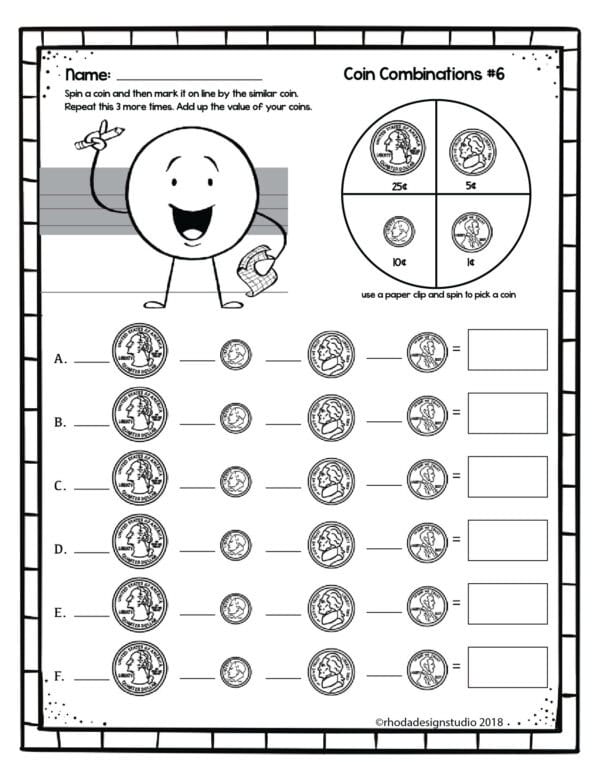


If you want ready-to-use activities, look for Counting Coins and Making $1.00 Worksheets that include sorting, matching, and real-world word problems.