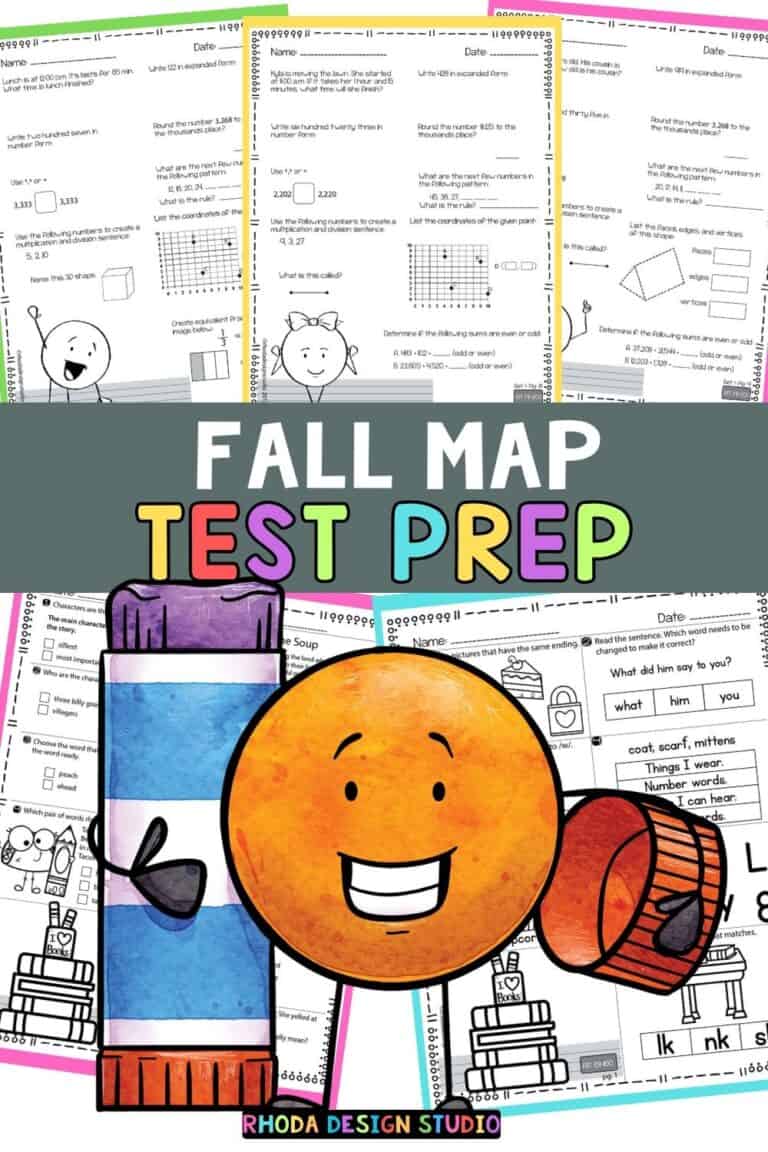
RIT 171-180 Activities: What to Teach Math and Reading at This Band
You opened the Learning Continuum and your student tested at RIT 175. Maybe RIT 178. Somewhere in the 171-180 band — that big middle range where roughly half your small-group students live. Now you need to figure out what to actually teach them this week.
This post is the answer for the 171-180 band specifically. Math AND reading skills broken down to what students at this band are ready to learn next, with activity ideas you can pull tomorrow morning. Built for K-5 teachers and interventionists who already know how to teach and just need the band-by-skill bridge.
The free score tracker linked at the bottom is what most teachers use to keep their group rosters and priority skills straight all year. Grab it before you start planning.
Who’s at RIT 171-180?
This band is the most-populated range in elementary classrooms because it’s where TWO different student groups overlap:
- On-grade-level students in 1st and early 2nd grade. The fall norms for 2nd grade typically land in this band, so students testing here in fall are exactly where they’re expected to be.
- Below-grade-level students in 3rd through 5th grade. Students who scored here in upper-elementary grades are likely candidates for Tier 2 small-group support.
Same RIT band, very different classroom contexts. The skills below are what these students are ready to work on regardless of grade — which is exactly why band-based grouping (rather than grade-based grouping) makes pull-out time so much more efficient for interventionists. A 4th grader at RIT 175 and a 1st grader at RIT 175 are working on similar skills in your small group.
Math Skills at RIT 171-180
Math at this band sits at a crucial transition: students are moving from “addition and subtraction within 20” toward early multiplication concepts. That shift is what most of the work at RIT 175 is built around.
Operations & Algebraic Thinking
This is the heaviest content area at this band. Students at RIT 171-180 are working on:
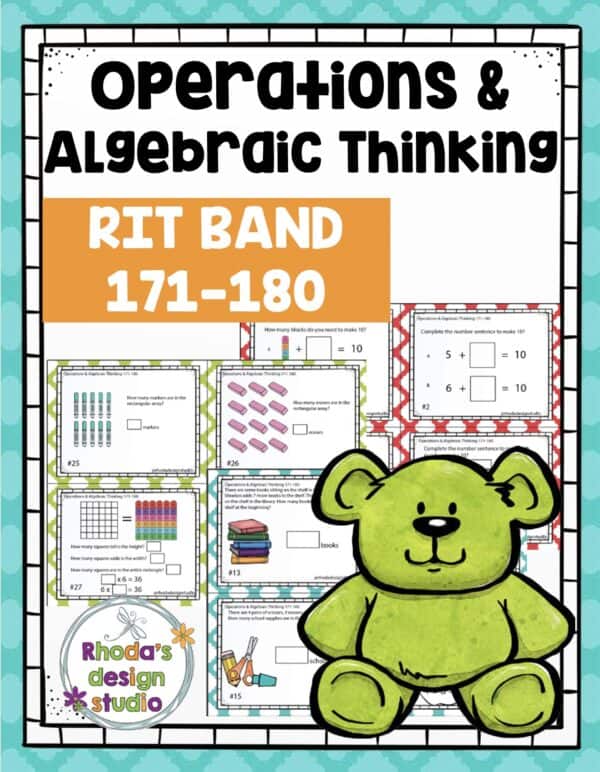
- Determining basic addition facts (sums less than 20)
- Solving subtraction problems (numbers less than 20, including the difference between two-digit numbers under 100 with no regrouping)
- Fluently adding and subtracting within 20 (horizontal AND vertical formats — students need both)
- Representing multiplication word problems (1-digit factors, products less than 100)
- Representing division as equal sharing with an equation (2-digit dividend, 1-digit divisor)
- Solving multiplication and division word problems with answers less than 20
- Solving simple two-step addition word problems
Activity ideas for Operations
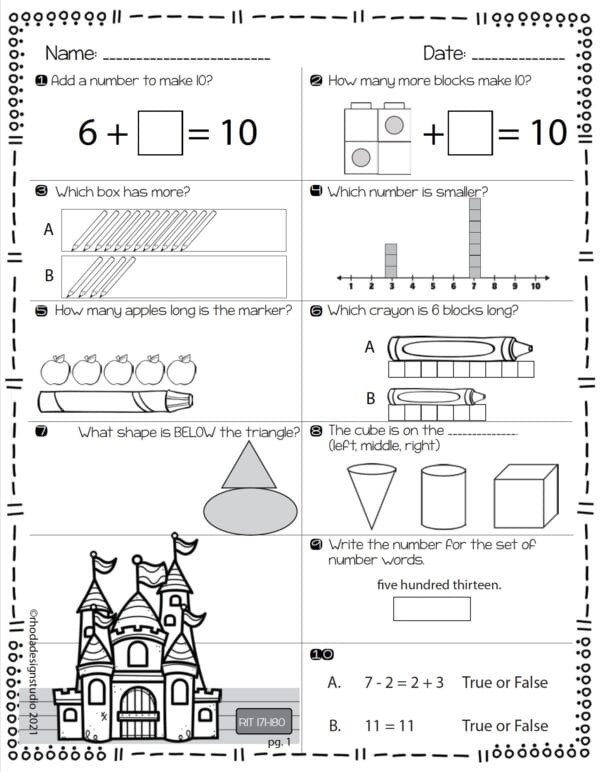
- Fact fluency cards at the under-20 sum/difference level, used in 5-minute warm-ups with the small group
- Multiplication-as-repeated-addition introduction using arrays drawn on dry erase boards (3 rows of 4 dots = 3+3+3+3 = 12)
- Equal sharing manipulatives for division concepts — counters split into equal groups, then translated to a written equation
- Word problem sorts where students categorize problems as “addition,” “subtraction,” “multiplication,” or “division” before solving — focuses on reading the problem, not just calculating
Number & Operations
Place value and multi-digit operations dominate this band:
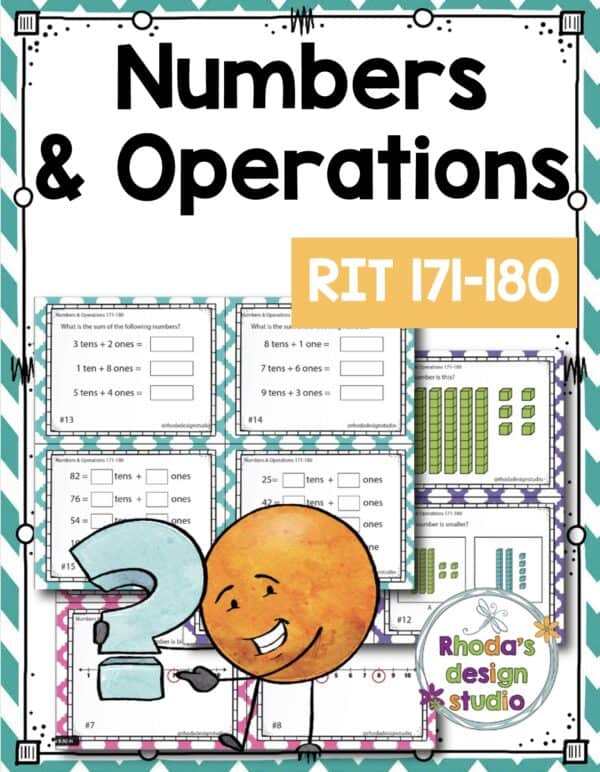
- Identifying the number of 10s and 1s (and starting to identify groups of 100) in a given number
- Adding and subtracting 2-digit numbers with sums and differences under 100, both horizontal and vertical formats
- Representing sets of objects as 10s and 1s
- Rounding numbers to the nearest 10 (under 100)
- Counting by 10s under 1,000 (including non-multiples of 10)
- Multiplying 1-digit numbers by 10 (introducing the foundation for later place-value multiplication)
Activity ideas for Number & Operations
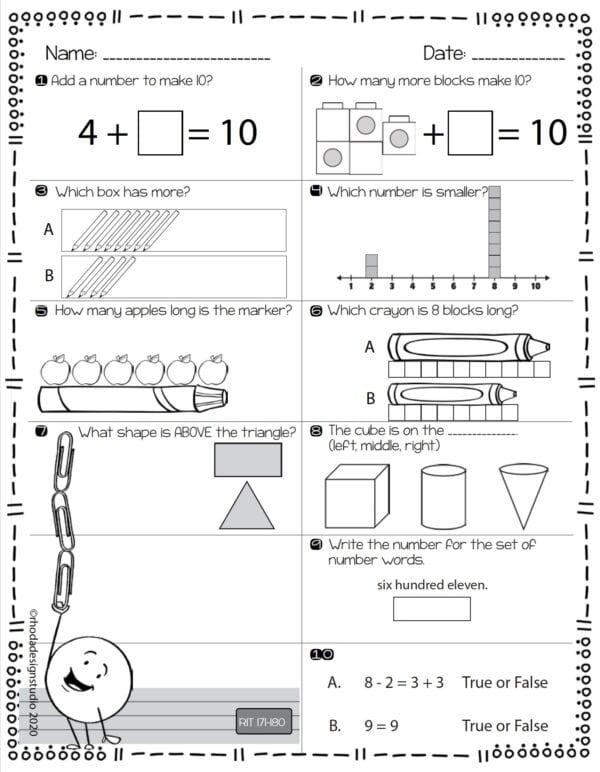
- Place value blocks (base-10 blocks) for any work with 10s and 1s — concrete first, then drawn, then symbolic
- 2-digit addition/subtraction worksheets in vertical format (since horizontal-only work doesn’t always transfer)
- Number lines for rounding to the nearest 10 — students physically move along the line to find the closer multiple
- Skip counting choral practice by 10s starting at numbers like 23 or 47 — not just from zero
Measurement & Data
Students at this band are working with:
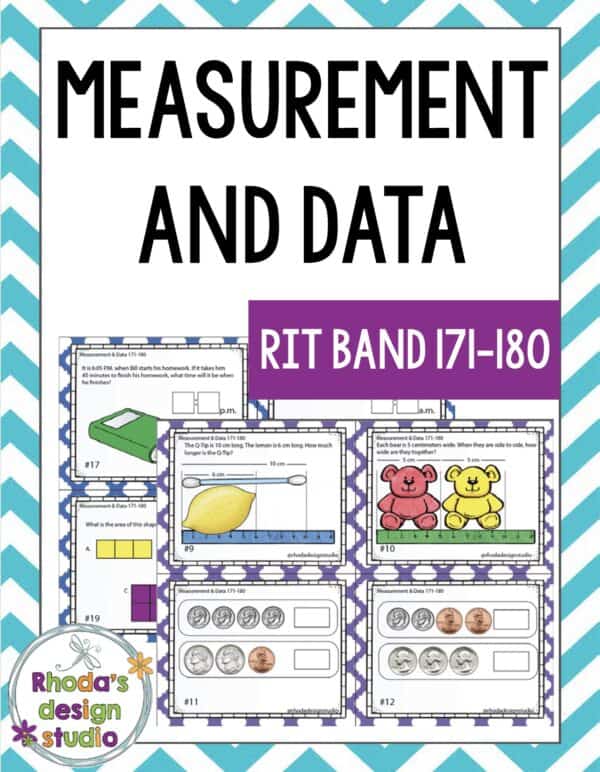
- Reading analog clocks to the nearest half hour
- Determining the value of coin collections (sums under $0.50, then under $1)
- Measuring the length and width of objects in cm and inches (with a ruler given)
- Estimating length (under 1 foot)
- Determining the perimeter of a square in non-standard units
- Comparing values of coin collections using “more” and “most”
Geometry
Lighter content load at this band, but two skills appear:
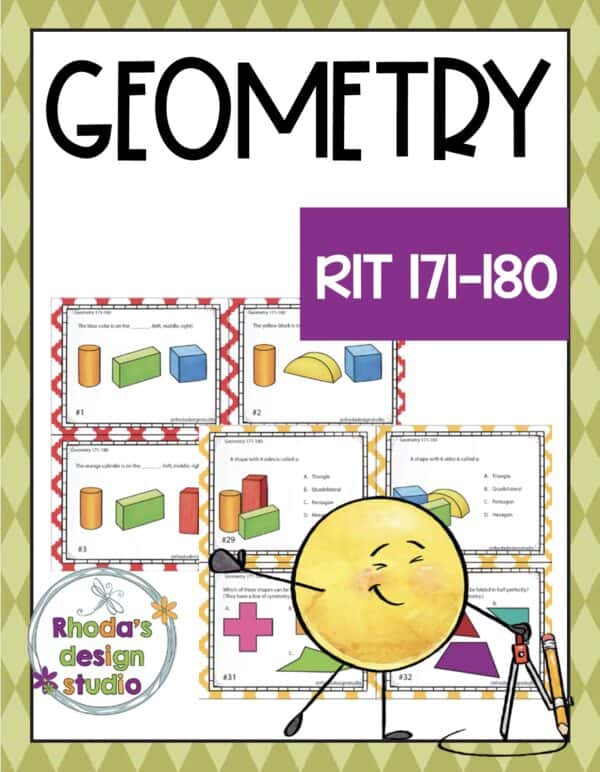
- Identifying and naming shapes by specified attributes
- Recognizing lines of symmetry and determining how many a shape has
Reading and Language Skills at RIT 171-180
Reading at this band is the transition from foundational decoding to early comprehension work. Students are still consolidating phonics but are increasingly reading for meaning.
Phonics & Foundational Skills
- Identifying the number of words in a sentence and recognizing word spaces
- Selecting words that rhyme (with different spelling patterns — e.g., “play” and “weigh”)
- Matching ending sounds of words
- Identifying given sight words in isolation and in sentences (words like “of,” “full”)
- Counting syllables in words (including 2- and 3-syllable words)
- Matching sounds to spelling patterns (e.g., “ay” → “play”)
Activity ideas for Phonics
- Rhyming sorts with different spelling patterns — students often default to spelling-based rhymes; this band needs sound-based rhyming practice
- Sight word fluency drills — flashcards or short practice passages with target sight words highlighted
- Syllable clapping or tapping — students physically count syllables before writing the number
- Sound-spelling matching cards — given a sound (e.g., “ay”), students match to the word(s) that contain that sound
Reading Literature
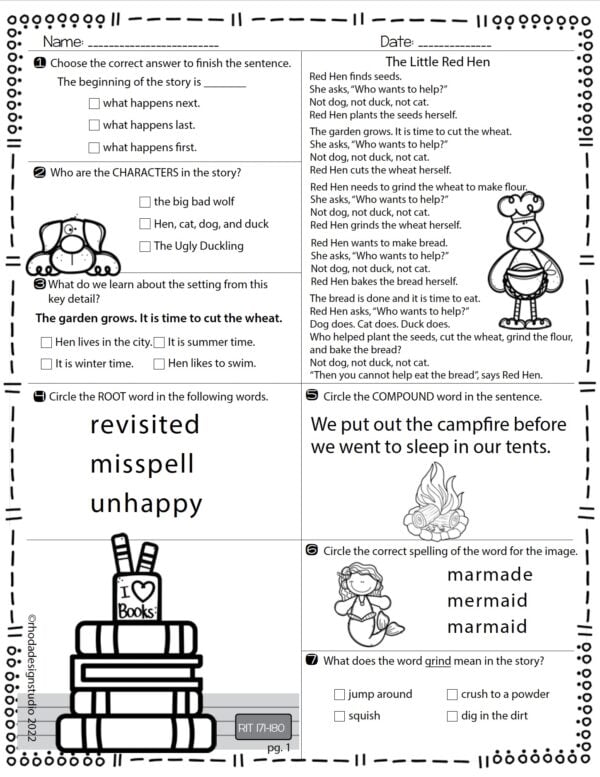
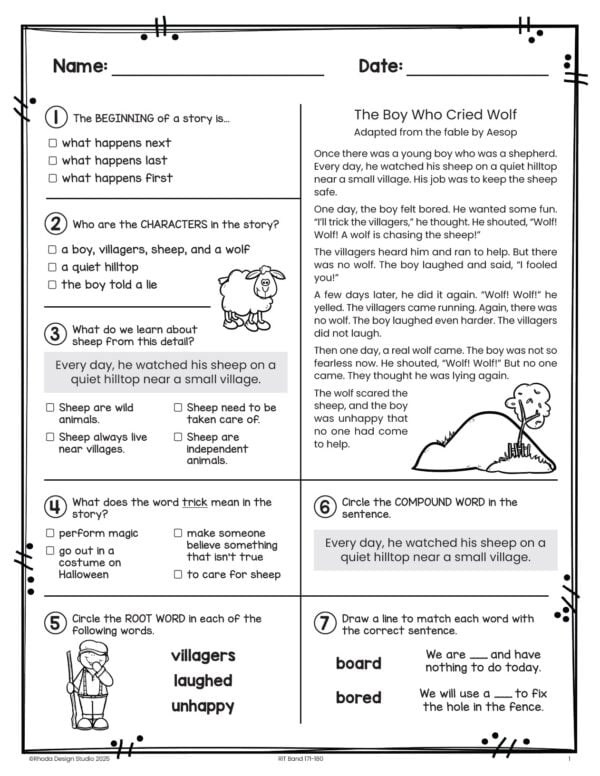
- Retelling stories with key details and identifying central messages
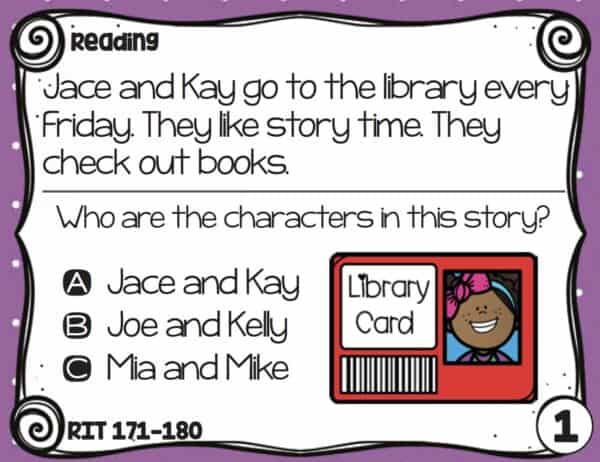
- Identifying characters, settings, and major events
- Describing how characters respond to events and challenges
- Recognizing common types of texts (storybooks vs. poems)
- Identifying who is telling the story at various points
- Using illustrations and details to demonstrate understanding of characters, setting, or plot
- Inferring character traits, problems, and settings from descriptions
- Identifying words and phrases that suggest feelings or appeal to the senses
Reading Informational Text
- Identifying the main topic and retelling key details (with prompting and support, then independently)
- Describing connections between two individuals, events, ideas, or pieces of information
- Locating cause-and-effect relationships
- Using text features like captions, bold print, subheadings, table of contents, and tabs
- Identifying the main purpose of a text
- Describing how reasons support specific points the author makes
- Distinguishing fact in given sentences
Activity ideas for Reading Comprehension
- Retell with picture supports — students sequence story-event cards before retelling verbally
- Character feelings cards — match descriptions to feelings or trait words
- Text feature scavenger hunts in informational texts — find the captions, the bold words, the table of contents
- Cause-and-effect sentence sorts with simple two-clause sentences
Language Arts
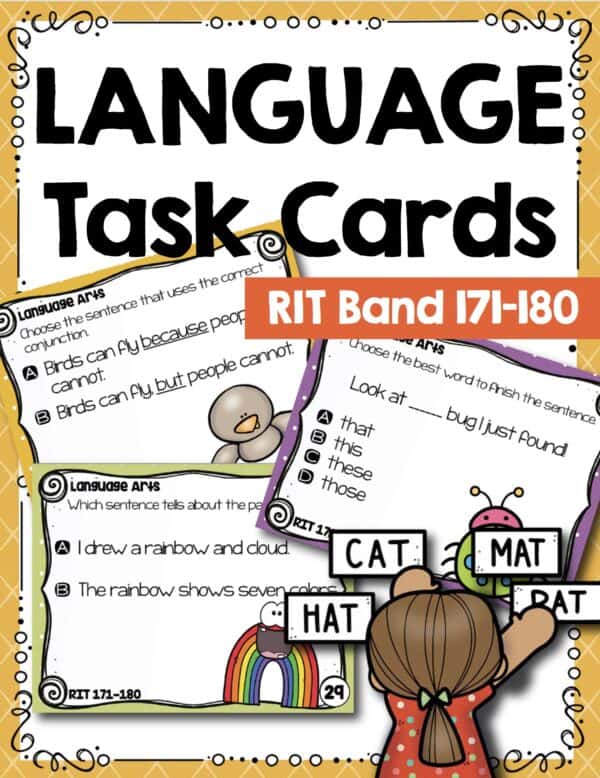
- Creating sentences using given words (six-word sentence range)
- Detecting subject/verb agreement errors
- Editing for capitalization (first word, proper nouns, friendly letter format)
- Using commas correctly in dates and lists
- Spelling sight words correctly (would, many, turn, said, bird, these)
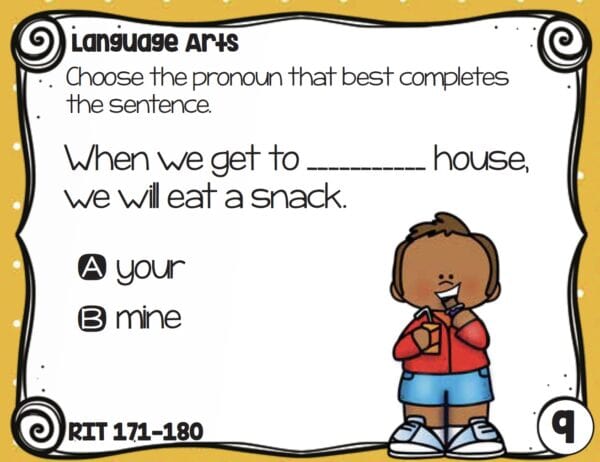
- Using reflexive pronouns (myself, ourselves)
- Using verbs in past, present, and future tense
- Using adjectives and adverbs correctly
- Using common conjunctions (and, but, or)
Vocabulary
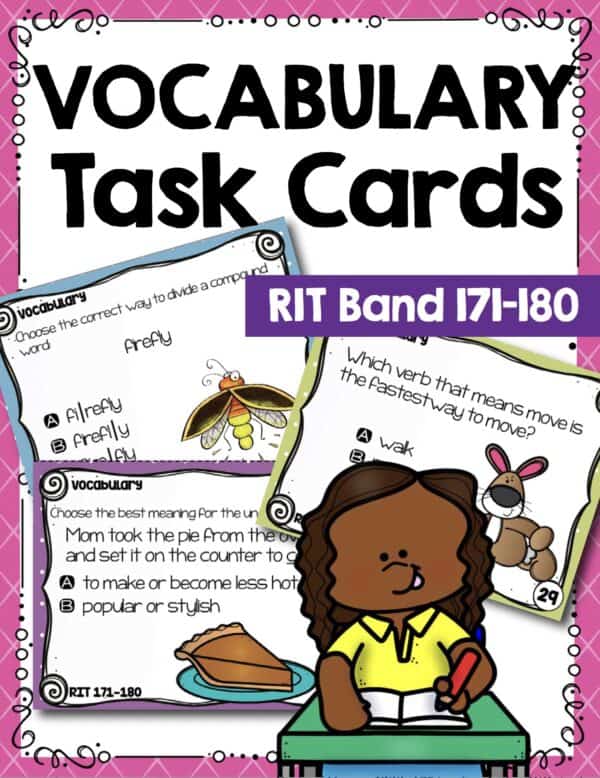
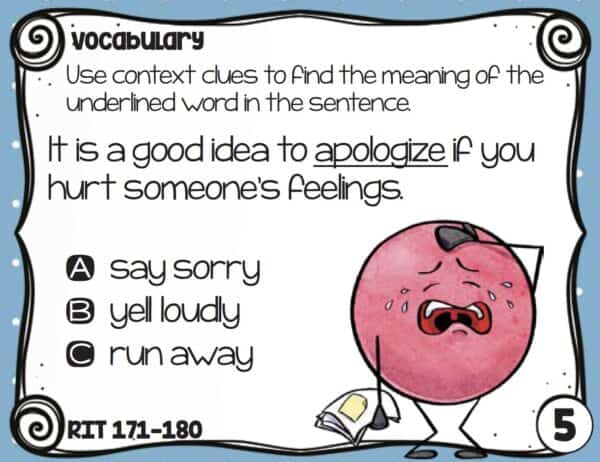
- Using sentence-level context as a clue to word meaning
- Locating word meanings within paragraphs
- Using inflections and affixes (and identifying base words)
- Predicting compound word meanings (birdhouse, lighthouse)
- Sorting words into categories
- Identifying synonym pairs
- Beginning idiom recognition (it’s raining cats and dogs)
Building a Small Group at RIT 171-180
If you have multiple students in this band, here’s the practical structure for the first month of small group instruction:
Pick ONE priority skill per subject per group
Don’t try to address every skill listed above. Pick one math focus and one reading focus that the most students in the group need. Common high-leverage choices for this band:
- Math: addition fluency within 20, OR 2-digit addition without regrouping, OR multiplication as repeated addition
- Reading: sight word fluency, OR retelling with key details, OR identifying main idea in informational text
Three weeks of focused practice on one skill produces more growth than three weeks of touching ten skills lightly.
Frequency and duration
Students at RIT 171-180 typically need 3 sessions per week of 15-20 minutes each for measurable growth on a target skill. More frequency, smaller duration, beats once-a-week longer sessions for this age group.
Materials
The biggest time-sink at this band is finding materials that match the band rather than the grade level. Most curricula are organized by grade — which means a 3rd grader at RIT 175 needs a worksheet from the 1st-2nd grade range, not the 3rd grade range. Hunting for those materials each week eats prep time.
The RIT Intervention System is built around band-organized materials — every worksheet, task card, and intervention pack is sorted by RIT band rather than grade. For a teacher running RIT 171-180 small groups, that means pulling from the 171-180 folder regardless of who’s at the table. Same source for the 4th grader and the 1st grader.
Stop the guessing game….
When parents and teachers see the same roadmap, everything changes for the child in between.

Where This Band Sits in the Bigger Picture
RIT 171-180 is part of the larger picture of K-5 reading and math development. Students typically progress out of this band into the 181-190 range, where multi-digit operations and longer-text comprehension become the focus.
For the broader band-by-band context, see the math fluency activities by RIT band and reading fluency activities by RIT band overviews. For interpreting the score that puts students at this band, see how to read a MAP report. For the full index of all K-5 RIT bands, see RIT Band Activities.
Free MAP Score Tracker
The score tracker is a one-page-per-class document with columns for fall, winter, and spring scores plus seasonal goal cards. It includes:
- A roster row per student
- Math and reading columns side by side
- Notes space for priority skills and group placement
- Seasonal goal cards for fall, winter, and spring
- A version formatted for MTSS documentation
Drop your email below and the tracker comes to your inbox.
Frequently Asked Questions
What grade level is RIT 175?
RIT scores don’t translate directly to grade levels. RIT 175 is roughly the fall norm for 2nd graders, but the same score means something different for a 1st grader (above the typical range) versus a 4th grader (below). The RIT score tells you what skills the student is ready to learn next, not what grade they “should” be in.
How long do students typically stay in the RIT 171-180 band?
It varies, but younger students typically move through bands faster than older students. A 1st grader on grade level might move from 171-180 to 181-190 across a single school year. A 4th grader receiving Tier 2 intervention at this band might take longer because they’re filling foundational gaps.
What’s the best math worksheet for RIT 175?
The best worksheet depends on the priority skill you’ve identified, not the score itself. For most groups at this band, the highest-leverage choices are addition fluency (sums under 20), 2-digit addition without regrouping, or multiplication as repeated addition. Pick one and stay with it for at least three weeks before changing.
My student is at RIT 175 in 4th grade. What does that mean?
It means your student is ready to work on the skills typical of 1st-2nd grade norms. That doesn’t mean “they belong in 1st grade” — it means small-group instruction targeting RIT 171-180 skills will likely be the most productive use of pull-out time. Core grade-level instruction continues as appropriate, with intervention filling in the prerequisite skills.
How do I write goals for a student at RIT 175?
Tie the goal to a specific skill at this band, not to a target RIT score. “Student will fluently add within 20 with 90% accuracy on a timed probe by winter testing” is a measurable goal. “Student will reach RIT 185 by winter” is a comparison, not a goal — and it depends on factors outside your control.
Can the same activities work for both math and reading groups at this band?
The skills are different, so the materials will be different. But the structure can be the same: 15-20 minute small groups, three sessions per week, one priority skill per cycle. Many teachers run their math group and reading group at the same band level back-to-back during their intervention block.
What if my student is at RIT 178 — closer to 181 than 171?
Students at the upper edge of a band are often ready to start working on skills from the next band up. Look at the standards listed for 181-190 and pick a skill that bridges the two bands — for example, multiplication facts within 100 (an 181-190 skill) builds on multiplication as repeated addition (a 171-180 skill).
How often should I retest students at this band?
The full MAP test runs three times a year — fall, winter, spring. Don’t retest the full MAP between windows. Use quick skill-specific probes every 2-3 weeks to monitor progress on your priority skill. That tells you whether the intervention is working without the time and emotional weight of a full retest.
Save This for Planning
Pin this so you have the band-specific skills handy each time you’re building small groups — fall, winter, or spring.
Final Thoughts
RIT 171-180 is the most-populated band in elementary classrooms because it’s where on-grade younger students and below-grade older students overlap. Same band, two contexts, identical instructional needs. Pick one priority skill per subject. Run three 15-minute sessions a week. Monitor with quick probes, not full retests. By winter MAP, you’ll have weeks of practice notes and a clear picture of who grew and who needs the next intervention layer.