How to Talk to Parents About MAP Scores: A Teacher’s Script
The conference is at 4:15. The MAP report is in the parent portal. The parent has already seen the percentile, and you can tell from the email they sent yesterday that they have questions. The score isn’t terrible. It’s also not what they were expecting. And in 20 minutes, you’re going to be sitting across from them at a tiny table.
This post is the script. Not a generic “communicate with empathy” post — actual lines you can use, structured around the conversations that actually happen during conference week. Built for K-5 teachers who already know how to teach and just want a structured way to handle the score conversation without getting derailed.
There’s a free score tracker at the bottom of the post. It’s the document you’ll want in front of you during the conference — or to send home as a follow-up.
Why MAP Conversations Feel Harder Than Other Score Conversations
Talking about a spelling test grade is straightforward. Talking about a MAP score isn’t, and it’s not your imagination. Three things make MAP conversations uniquely hard:
- The score is a percentile. Every parent immediately mentally compares their child to “average” — which is a loaded comparison no other classroom assessment forces.
- The test is high-stakes-feeling. Even when the school doesn’t use MAP for grades, the test FEELS high-stakes because it’s standardized, timed, and on a national scale.
- You’re delivering it under time pressure. Conference slots are 15 minutes. There’s no room for a 30-minute walkthrough of what RIT means.
The strategy this post uses: a five-part script that fits inside 8-10 minutes (leaving room for the parent’s questions), with branching scripts for the harder conversations. You won’t use every line in every conference. You’ll use what matches the situation.
Before the Conference: Three Minutes of Prep
Before any MAP conversation, you need three pieces of information at your fingertips. Not the full report — these three things, written on your tracker:
- The student’s percentile. Not the RIT score. The percentile is what the parent will compare against “average.”
- The trend. If you have multiple testing windows, is the score going up, down, or flat?
- The priority skill. The one thing you’ve identified as the focus for this student in small groups.
Three numbers, three pieces of information. That’s the entire briefing book you need. Have it written down so you’re not searching through the report mid-conference.
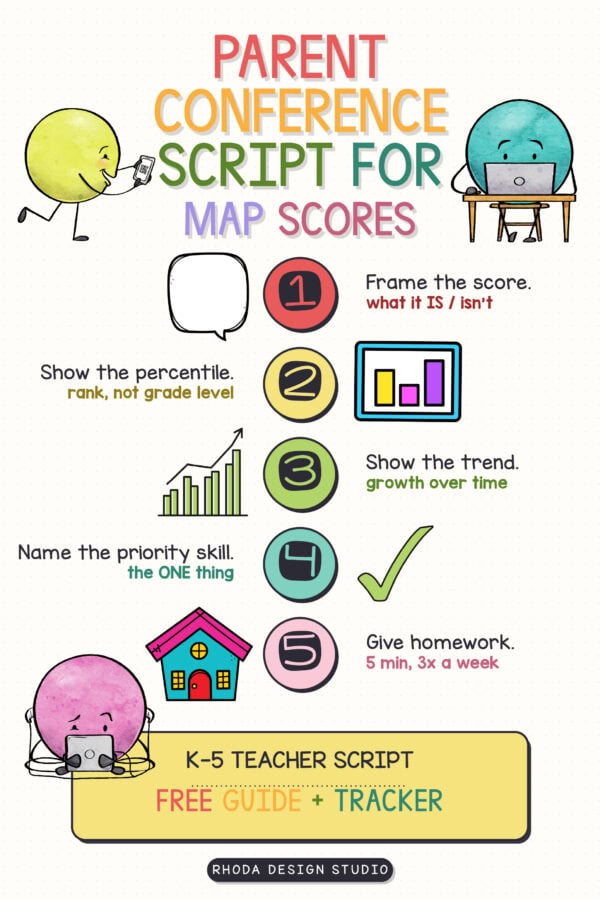
The Five-Part Script
Use this as the structure for the score portion of any conference. It takes 8-10 minutes, leaving room for parent questions before the conference ends.
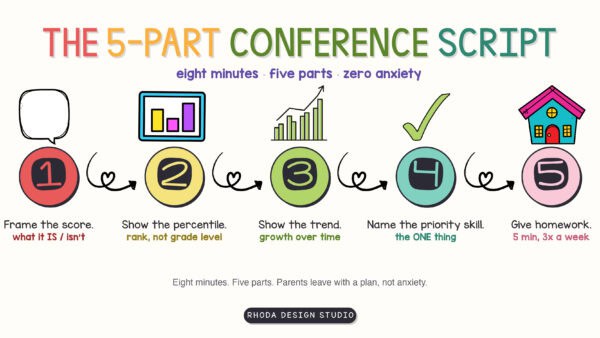
Part 1: Frame what the score IS (and isn’t)
Start before the parent sees the number. Quick, calm framing.
“Before we look at the MAP results, I want to mention something that helps put them in context. The MAP test isn’t graded — it’s a tool we use to figure out what to teach next. The score tells me where to start with [Student], not whether they’re ‘doing well’ or ‘not doing well.’ I’ll show you the percentile too, which is the comparison most parents are looking for, but the most useful information for me as a teacher is what skills [Student] is ready to work on next.”
This sentence does the heavy lifting for the rest of the conversation. You’ve reframed the score from “how is my child doing” to “what’s the plan.” Most parents will follow your frame if you provide one.
Part 2: Show the percentile, not the RIT
The percentile is what parents want. The RIT score is what you want. Lead with theirs.
“In reading, [Student] scored at the [X] percentile. That means out of 100 students in [grade] taking the test in [season], [Student] scored higher than [X] of them. The middle of the pack is roughly the 40th to 60th percentile, so this puts them [in/above/below] that range.”
Don’t say “average” if you can help it — say “middle of the pack” or “typical range.” Average is loaded language for parents.
Part 3: Show the trend
One score is a snapshot. A trend is a story. The story is more useful.
“What I find more useful than the single score is the trend. Last [season] [Student] was at [previous percentile]. This [season] they’re at [current percentile]. So we’re seeing [growth/stability/decline], which tells me the work we’re doing in small groups is [helping/holding steady/needing to be adjusted].”
If you only have one testing window so far, say so: “This is our first window of the year, so we’ll have a clearer picture in winter when we can see the trend.”
Part 4: Name the priority skill
This is where you sound like a professional with a plan, not a person reading a report.
“Based on this score, our focus for [Student] right now is [specific skill]. They’re working on this twice a week in small group, and we’ll check progress in [X weeks]. The MAP test will retest this in [next testing window].”
Specific. Time-bound. Confident. The parent now sees that “below average percentile” doesn’t equal “no plan.”
Part 5: Give them something to do at home
Most parents leave conferences wanting to help. Give them one specific thing.
“At home, the most useful thing you can do is [one specific, low-pressure activity tied to the priority skill]. Not test prep — just that skill in a casual, daily-life context. Five minutes a day matters more than a tutoring session once a week.”
Examples by skill:
- Multiplication fluency: “Math facts in the car. Times tables on the way to school.”
- Reading comprehension: “Read a short article together once a week and ask ‘what was the main idea?'”
- Phonics: “When you read together, pause on tricky words and have them sound it out instead of you supplying it.”
- Word problems: “When you’re cooking together, ask ‘if we double the recipe, how much flour?'”
The parent leaves with a job. That’s a better feeling than leaving with anxiety.
Hard Questions: Branching Scripts
Here are the questions parents actually ask, and how to handle them without getting derailed.
“Is my child behind?”
“Behind isn’t quite the right frame for MAP. The test measures what skills your child is ready to learn next, not where they ‘should’ be by grade. What I can tell you is [Student] is currently at the [X] percentile, which puts them [in/above/below] the typical range. More importantly, here’s what we’re doing about it: [priority skill, plan, timeline].”
You acknowledged the question, gave a real answer, and pivoted to the plan. Don’t avoid the question — pivoting from a non-answer feels evasive. Answer it, then move forward.
“Why did their score go down?”
“Score variation between testing windows is normal — the MAP test has a measurement error of a few points, so a small drop isn’t always a real change. What I look at is whether the drop is part of a pattern. Looking at [Student]’s testing windows, I see [pattern]. Based on that, [either: ‘I’m not concerned because the trajectory overall is positive’ OR ‘I want to keep an eye on this and we’re already focused on [skill]’].”
The honest answer is “we don’t always know.” Don’t pretend you do. But always close with what you’re doing.
“Should we get a tutor?”
“Tutoring can help, but it depends on what your child needs. The work we’re doing in small group is targeted to [specific skill] and we’re checking progress every [X weeks]. If you want to add support at home, the most useful thing is [low-pressure home activity]. If after [winter/spring testing] we’re not seeing the growth we’d expect, we can revisit the tutoring conversation then with more data.”
You didn’t say no. You also didn’t agree to a tutor without information. You gave them a checkpoint to revisit.
“My other child scored higher at this age.”
“Every child develops on their own timeline, and the MAP score reflects what skills they’re ready to work on now. Comparing siblings on a single test isn’t usually useful — what matters is [Student]’s growth over time and what they’re working on. Here’s where they are and what we’re focused on…”
Refuse the comparison gently. Pivot back to the individual student.
“Is the score on their permanent record?”
“MAP scores are stored in the student’s data file at the school, but they aren’t grades — they don’t appear on report cards or transcripts. They’re a tool we use internally to plan instruction. Many schools use them as part of the conversation about intervention or enrichment, but not as a public-facing score.”
Verify your school’s actual policy before using this verbatim — schools handle MAP data differently. If you don’t know, say so: “I’d want to check with our front office on the specific policy. What I can tell you is it doesn’t appear on report cards or transcripts.”
“Can you show me the actual report?”
Some parents want to see the data themselves. That’s reasonable. But the report is dense, and you have 12 minutes left in the conference.
“Yes — the family report is in the [parent portal/email]. Can I walk you through what to look at first? The percentile and the achievement level are the most useful sections. There’s also a Learning Continuum that lists hundreds of skill statements — that’s reference material rather than something you need to study, but it’s there if you’re curious.”
Direct them, don’t hide from them. The report is going to find them eventually. (Get more information on how to discuss MAPs Reports here.)
What NOT to Say
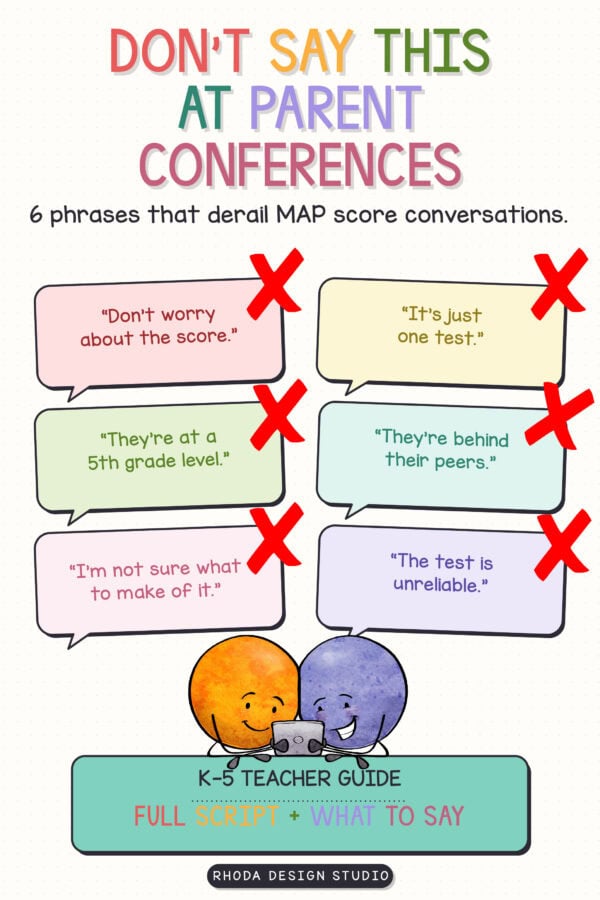
Phrases that derail parent conferences in MAP conversations:
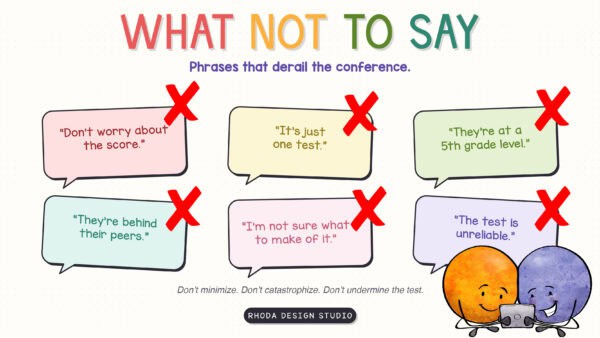
- “Don’t worry about the score.” If they’re at the conference, they’re already worrying. This sounds dismissive.
- “It’s just one test.” True, but the parent already knows that. This sounds like you’re minimizing their concern.
- “Their score is at the [grade level X] level.” RIT scores don’t translate to grade levels. This is technically inaccurate, and parents who later look it up will lose trust.
- “They’re behind their peers.” “Behind” is a word that triggers shame and panic. Use “below the typical range” or “in the lower band” if you need to convey the same information.
- “I’m not sure what to make of it.” Even if true, this sounds like you don’t have a plan. Always close with what you’re doing, even if it’s “watching for the next data point.”
- “The test is unreliable.” Even if you have professional concerns about MAP, the conference isn’t the place. It undermines the data you’re using to plan instruction.
The unifying principle: don’t minimize, don’t catastrophize, don’t undermine the test. Acknowledge the score honestly, and pivot to your plan.
When You Don’t Have a Plan Yet
Sometimes scores arrive Tuesday and conferences are Wednesday. You haven’t built small groups yet. The honest version of the script changes:
“The scores just came in this week, so I’m still working through what they mean for our small groups. Based on what I’m seeing for [Student], I’m planning to focus on [priority skill area] in the coming weeks. I’ll send a follow-up note in [X weeks] with the specific plan and how we’ll track progress.”
“I’m still working through this” is professional. “I don’t know” is not. The first acknowledges that interpretation takes time. The second sounds like you don’t read your data.
If you find yourself in this situation often, the score tracker is the simplest fix — having scores transcribed into one document gets you to “I have a plan” faster after every testing window.
After the Conference: The Follow-Up Email
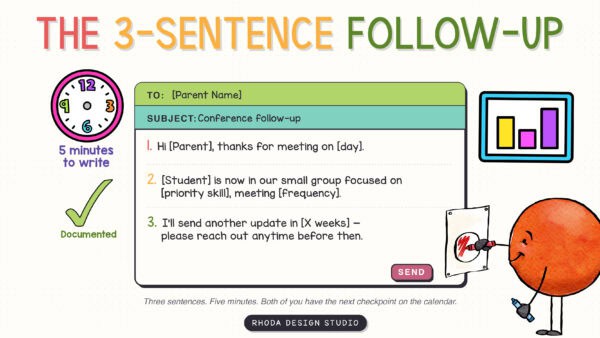
For any conference where the parent had concerns, a brief follow-up email within a week solidifies the plan. Three sentences, max.
“Hi [Parent], thanks for meeting on [day]. As a quick follow-up: [Student] is now in our small group focused on [priority skill], meeting [frequency]. I’ll send another update in [X weeks] with progress, but please reach out if you have questions before then.”
That’s it. The parent has documentation of the plan in writing. You have a record of what you committed to. Both of you have the next checkpoint on the calendar.
For the Skeptical Parent
Some parents come into the conference assuming you don’t have a plan, or that MAP is meaningless, or that the school is making decisions based on bad data. The way to disarm skepticism is competence, not defensiveness.
What competence looks like in this conversation:
- You know the percentile without checking your laptop
- You can name the priority skill in one sentence
- You have a written plan in front of you (the score tracker, your small group roster, your weekly schedule)
- You acknowledge the limits of MAP without dismissing it
- You name the next checkpoint
Most skeptical parents are reassured by a teacher who clearly has read the data and made decisions from it — even if they remain skeptical of the test itself. The system you’re working with does the heavy lifting here. Teachers who use a band-organized intervention system tell us this often: the documentation is what carries the conversation.
One teacher described it this way:
“I have been using these for interventions during math MTSS. They have been working great, and target the specific levels different students are on.”
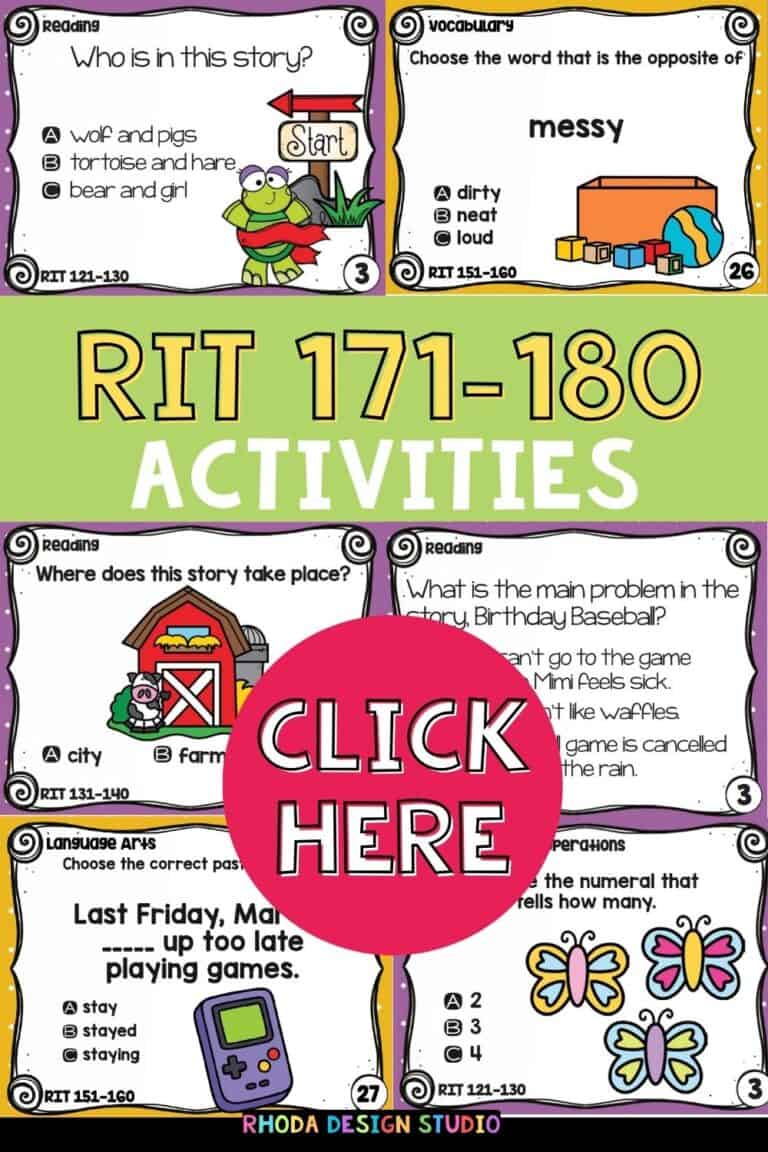
That clarity — “specific levels different students are on” — is what shows up in a confident parent conversation. The RIT Intervention System is built around this approach: practice materials organized by RIT band so that for any student at any score, there’s a worksheet, task card, or activity ready to go. Walking into a conference with that level of preparation makes the parent conversation different.
Stop the guessing game….
When parents and teachers see the same roadmap, everything changes for the child in between.

For the full index of all K-5 RIT bands, see RIT Band Activities.
Free MAP Score Tracker
The score tracker is a one-page-per-class document with columns for fall, winter, and spring scores plus seasonal goal cards. Bring it to the conference. It includes:
- A roster row per student
- Math and reading columns side by side
- Notes space for priority skills and group placement
- Seasonal goal cards for fall, winter, and spring
- A version formatted for parent communication
Drop your email below and the tracker comes to your inbox.
Frequently Asked Questions
Should I send the MAP report home before the conference?
Most schools push family reports through the parent portal automatically, so parents already have access. If yours doesn’t, sending the report a day or two before the conference gives parents time to look it over without ambushing them. Avoid the day-of email — that creates anxiety without giving you time to address it together.
What if a parent disputes the score?
Listen first. Some disputes are about real testing concerns (their child was sick, distracted, didn’t understand the format) — those are worth documenting and possibly retesting. Others are about the parent’s expectations not matching the data. For both, your move is the same: acknowledge the concern, present the data you have, and propose a checkpoint at the next testing window to revisit.
How do I explain RIT scores to parents who’ve never seen one?
Don’t, unless they ask. Lead with the percentile because it answers their actual question. If they want more, the simplest explanation is: “RIT is a measurement scale that tells me what skills your child is ready to learn next. The number itself isn’t a grade level — it’s a tool for me to plan instruction.” Read this post for additional information.
What if the parent wants more frequent updates?
A monthly email update is reasonable for parents of students in active intervention. Keep it short — three sentences, mirroring the post-conference follow-up template. Don’t promise weekly updates unless the school’s communication norms require it; that’s not sustainable across a class of 25.
Should I tell parents their child is in the “low group”?
Avoid group labels in parent conversations. Talk about the skill the student is working on, not the label of the group. “[Student] is working on multiplication fluency twice a week with me” is more useful than “[Student] is in the low math group” — and it’s accurate without creating stigma.
What if the parent gets emotional?
Pause. Hand them a tissue if needed. Don’t try to talk them out of the emotion. When they’re ready, say something like: “I know this is hard to see. The most important thing I want you to leave with is that we have a plan, and I’m going to walk you through it.” Then continue with the priority skill and timeline.
What if I disagree with the score?
Don’t share that disagreement during the conference. The score is what it is. Document your professional observations alongside the score in your tracker, use both to plan instruction, and bring up your concerns to the school’s data team or your principal — not to parents. Parents need a teacher with a plan, not a teacher who’s questioning the test.
How long should the score conversation take?
Eight to ten minutes maximum. The five-part script keeps you on time. Leave the rest of the conference for the parent’s questions and broader topics — behavior, friendships, classroom engagement. The MAP score is one piece of the conversation, not the whole thing.
What if scores arrive after the conference?
Send a one-page email summary with the percentile, the trend, and the priority skill. No phone call required unless the parent specifically requests one. The email creates documentation, gives the parent something concrete, and respects everyone’s time.
Save This for Conference Week
Pin this so you have the scripts and branching answers ready when conference week shows up — fall, winter, or spring. The same five-part structure works every time.
Final Thoughts
The MAP score conversation is one part of a parent conference, not the whole thing. Eight minutes, five parts, scripted enough that you don’t have to improvise the hard moments. The parent leaves with a percentile, a plan, and one specific thing to do at home.
Most importantly: you leave the conference with what you came in with — your professional confidence intact, your plan documented, and the next checkpoint on the calendar.